

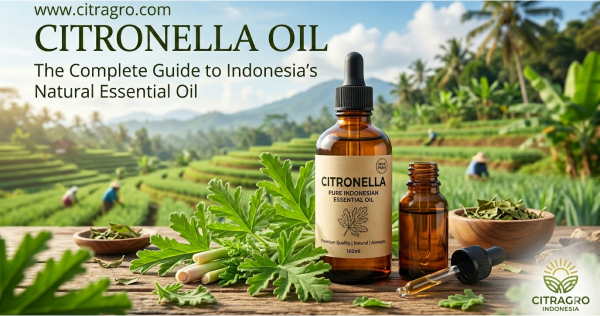
Citronella Oil: The Complete Guide to Indonesia’s Natural Essential Oil
Citronella oil, known in Indonesian as minyak sereh wangi, is an essential oil derived from the leaves and stems of aromatic grasses belonging to the genus Cymbopogon, primarily Cymbopogon nardus and Cymbopogon winterianus. This pale-yellow liquid with its distinctive sharp citrus scent has been treasured by indigenous communities across the Indonesian archipelago for generations before gaining worldwide recognition.
What makes this oil truly special is not just its refreshing aroma but its scientifically proven ability to repel mosquitoes and other insects naturally. Indonesia stands as one of the world’s leading producers and exporters of citronella oil, with the Java variety—widely known as Java Citronella Oil—recognized internationally as a premium product due to its high concentration of active compounds.
This comprehensive guide will take you through every aspect of citronella oil: from the botanical origins of the plant, through the distillation process passed down through generations, to its myriad applications and significant economic role in rural Indonesian communities.
Chapter 1: Getting to Know the Citronella Plant
1.1 Origins and Distribution
The citronella grass is not a newcomer to Indonesian soil. Although botanists believe the center of origin for the Cymbopogon genus lies in South Asia and tropical Africa, these grasses entered the Nusantara archipelago centuries ago through ancient spice trade routes. Indonesia’s warm, humid tropical climate proved exceptionally suitable for their growth, allowing them to adapt and even develop into superior local varieties.
Two main species are commonly cultivated in Indonesia, each with distinct characteristics:
Ceylon-type citronella (Cymbopogon nardus) features purplish stems at the base. This variety produces oil with a sweeter, more gentle aroma due to its relatively high geraniol content. However, its citronellal levels—the key mosquito-repelling compound—are somewhat lower.
Java-type citronella (Cymbopogon winterianus) has green to reddish stems and grows more upright than its cousin. This is the variety widely developed across Indonesia because it yields more oil and contains citronellal levels reaching 35-45 percent. Unsurprisingly, global market demand heavily favors this Java type.
1.2 Physical Characteristics You Can Recognize
Distinguishing citronella grass from other plants is not difficult once you know what to look for. The plant forms dense clumps with stem heights ranging from one to two meters. Its leaves are long, ribbon-like, and taper to sharp points like sword tips. The leaf edges feel rough and sharp—careful when handling them, as they can cut skin like a razor blade.
One unique feature of citronella grass is its leaf sheaths overlapping to form a false stem. Its fibrous root system grips the soil firmly, making the plant useful for erosion control on sloping land. When you crush a leaf, it releases a sharp, refreshing citrus aroma originating from essential oil glands distributed throughout the leaf surface.
1.3 Ideal Growing Conditions
To produce the highest quality oil, citronella grass requires specific environmental conditions. Across Indonesia’s production centers, cultivation typically occurs at elevations between 100 and 1,200 meters above sea level. Optimal temperatures range from 25 to 32 degrees Celsius with relative humidity around 60 to 80 percent.
The plant enjoys full sunlight but tolerates light shade. Ideal annual rainfall falls between 2,000 and 3,000 millimeters distributed evenly throughout the year. Extended dry seasons reduce oil production as the plants experience water stress. Conversely, waterlogging is harmful and can cause root rot. Therefore, well-drained soil is essential.
Remarkably, citronella grass can grow on land considered marginal or less fertile. This characteristic makes the plant a favorite for reforestation programs and economic empowerment initiatives in disadvantaged regions. Farmers need not spend heavily on fertilizers or intensive care.
Chapter 2: The Journey from Farm to Bottle
2.1 Traditional and Modern Cultivation Practices
Citronella cultivation in Indonesia remains dominated by smallholder farms with land areas ranging from half a hectare to several hectares. The most straightforward propagation method involves splitting mature clumps and replanting them in new fields. Farmers prefer this approach because growth is faster compared to seed propagation.
Common spacing ranges from 60×80 centimeters to 80×80 centimeters. Within two to three months after planting, the plants begin forming substantial clumps. Weeds require periodic removal, especially during early growth stages. Fertilization typically uses manure or compost readily available near the cultivation site.
In some regions, farmers have begun adopting more systematic cultivation practices using quality organic fertilizers and optimal spacing. Results show improved oil yields reaching up to 1.2 percent of fresh material weight.
2.2 Proper Harvest Timing
Determining the right harvest time is key to obtaining premium quality oil. The first harvest usually occurs when plants reach 6 to 8 months of age. At this stage, essential oil content in the leaves peaks. Signs of readiness include slight yellowing at leaf tips and increasingly sharp aroma.
After the first harvest, subsequent harvests can occur every 3 to 4 months. Farmers typically harvest in the morning after dew has evaporated. Cutting occurs approximately 20 to 30 centimeters above ground level, leaving the stem base so new shoots can quickly regrow. A healthy clump can continue producing for 4 to 5 years before requiring replacement.
2.3 The Wilting Process
Before distillation, freshly harvested citronella leaves and stems undergo drying or air-drying for about one day. This process, known as wilting, aims to reduce water content within plant tissues. Why is this important? Let’s understand.
When raw material water content decreases, the energy needed to evaporate water during distillation becomes lower. This means the process runs more efficiently and saves fuel. Additionally, wilting triggers enzymatic reactions that can improve the resulting oil’s aroma quality.
However, wilting cannot be extended too long. If left for more than 24 hours, light volatile compounds will escape, reducing both yield and oil quality. The optimal wilting temperature ranges from 30 to 35 degrees Celsius with good air circulation.
2.4 Distillation Method: Steam Distillation
Steam distillation is the most popular and efficient method for extracting citronella essential oil. Let’s examine each stage in detail.
Preparing the Still
Traditional distillation equipment in Indonesia typically uses modified steel drums or stainless steel vessels converted into steam stills. Capacities vary widely, from 100 kilograms to 1 ton of raw material per distillation run. Wiltted raw material is packed into the still firmly but not compressed too tightly so steam can still circulate smoothly.
Generating Steam
Water is heated in a separate boiler until boiling produces low-pressure steam. This steam then flows into the still containing citronella leaves through pipes entering from the bottom. Ideal steam temperature ranges from 100 to 110 degrees Celsius.
Oil Release
Circulating hot steam breaks down cell walls and oil glands within the leaves. Volatile essential oil compounds become entrained with the steam flow. This mixture of steam and oil vapor then travels toward the condenser.
Cooling and Condensation
The condenser typically consists of a long coiled pipe through which cold water flows continuously. When the vapor mixture passes through this cold section, it condenses into liquid phase. The condensation result—a mixture of water and oil—flows into collection vessels.
Separation
Because essential oil has lower density than water and does not dissolve in it, the oil naturally floats to the surface. Simple separation using a separatory funnel or a bottom drain valve separates the oil (upper layer) from the hydrosol water (lower layer). The entire distillation process lasts between 3 to 5 hours.
2.5 Yield and Influencing Factors
Yield refers to the ratio of oil volume produced to raw material weight used. Generally, from 100 kilograms of fresh citronella leaves, distillers obtain approximately 0.6 to 1.2 liters of pure oil. Several factors influence yield:
- Plant species – Java-type C. winterianus produces higher yields than C. nardus
- Harvest age – Plants aged 6-8 months provide optimal yields
- Distillation method – Steam distillation is more efficient than direct distillation
- Raw material quality – Overly mature or damaged leaves reduce yield
- Distillation duration – Too short yields low returns; too long degrades quality
Chapter 3: Chemical Composition and Quality Secrets
3.1 Aroma-Forming Compounds
Citronella oil is not a single substance but a complex mixture of over 80 different chemical compounds. Each contributes to the oil’s aroma, efficacy, and stability. Here are the most important ones.
Citronellal is the star of this oil. This aldehyde monoterpenoid provides the sharp, fresh lemon-like aroma. Java-type citronella oil contains between 35 and 45 percent citronellal. What makes it special is its scientifically proven insect repellent activity. Citronellal works by interfering with insects’ olfactory receptors, making them unable to detect hosts for blood meals.
Geraniol is the second most abundant compound. With an aroma reminiscent of roses, geraniol adds a gentle floral nuance beneath citronellal’s freshness. Its content typically ranges from 12 to 18 percent. Beyond serving as a fragrance fixative (helping scents last longer), geraniol exhibits fairly strong antimicrobial activity against various bacteria and fungi.
Citronellol has a chemical structure similar to geraniol but with different double bonding. Its aroma is sweeter and softer. This compound is often used in high-end perfumery for its ability to create an “uplifting” effect in fragrance compositions. Citronellol levels in citronella oil range from 11 to 15 percent.
Geranyl acetate is an ester formed from geraniol reacting with acetic acid. It contributes a sweet, fresh fruity nuance. Though present in smaller amounts (3-8 percent), its role in creating aroma complexity is significant.
Beyond these four major compounds, other important substances include limonene (citrus aroma), camphene (pine-like aroma), and several sesquiterpenes.
3.2 National and International Quality Standards
To ensure consistently traded citronella oil quality, Indonesia has established the Indonesian National Standard (SNI) numbered SNI 3953:2019. Here are the key parameters:
| Parameter | Requirement |
|---|---|
| Appearance | Pale yellow to light brown |
| Odor | Characteristic citronella, fresh, not rancid |
| Specific gravity (20°C) | 0.880 – 0.922 |
| Refractive index (20°C) | 1.4600 – 1.4780 |
| Citronellal content | Minimum 30% |
| Geraniol content | Minimum 11% (Java type) |
| Solubility in 80% alcohol | Clear solution at 1:3 |
Beyond SNI, exported citronella oil must also meet international standards such as ISO 3848:2016, which specifically regulates Oil of citronella, Java type. This ISO standard has similar parameters but with tighter tolerances.
3.3 How to Distinguish Genuine Oil from Adulterated Products
Unfortunately, as demand increases, adulterated or diluted citronella oil has become more common. As a savvy consumer, you need to know several simple ways to distinguish genuine from fake oil.
The smell test is easiest. Genuine citronella oil has a strong but natural fresh citrus aroma, not like sharp synthetic fragrances. If you detect turpentine-like or aggressively chemical notes, be suspicious.
The alcohol solubility test requires some equipment. Drop one drop of oil into a bottle containing 80 percent alcohol and shake. Genuine oil will dissolve clearly at a 1:3 volume ratio. If sediment forms or the solution turns cloudy, the oil has likely been mixed with vegetable fats or mineral oil.
The paper test is easy to do at home. Place one drop of oil on filter paper or plain white copy paper. Pure essential oil will evaporate completely within a few hours, leaving only a thin, non-greasy ring. In contrast, oil diluted with fatty oils leaves a greasy stain that never disappears.
The specific gravity test requires more precise equipment, but the principle is simple: genuine oil has a density of approximately 0.88 to 0.92 grams per milliliter—lighter than water (1.0).
Chapter 4: A Wealth of Benefits for Daily Life
4.1 Natural Mosquito and Insect Repellent
Undoubtedly, citronella oil’s most popular use is as an insect repellent. Let’s explore why this oil is so effective for this purpose.
Scientific studies conducted in various laboratories demonstrate that citronella oil effectively repels mosquitoes from three main disease-vector genera: Aedes (causing dengue hemorrhagic fever), Anopheles (causing malaria), and Culex (causing lymphatic filariasis/elephantiasis). Its mechanism does not kill mosquitoes but disrupts their sense of smell, confusing them and preventing them from detecting human presence.
Interestingly, comparative studies between citronella oil and the synthetic compound DEET widely used in commercial insect repellents show promising results. At the same concentration (e.g., 10 percent in lotion), DEET indeed provides longer protection (5-6 hours) compared to citronella oil (1-2 hours). However, DEET is known to have side effects such as skin irritation and, in certain cases, has been linked to neurological disorders. Meanwhile, citronella oil is considered safe for external use when properly diluted.
Common citronella oil-based repellent formulations found in the market include:
- Topical lotions – Mixed with carrier oils like coconut or olive oil
- Room sprays – Diluted with water and a mild emulsifier like polysorbate
- Aromatherapy candles – Citronella-containing candles release repellent aroma when burned
- Electric diffusers – Devices that convert oil into vapor using heat or ultrasonic vibration
4.2 Perfumery and Fragrance Industry
Citronella oil’s fresh, lively aroma makes it a highly valued ingredient in the fragrance industry. In perfume compositions, this oil typically serves as a top note—the initial scent perceived upon first spraying. The top note shapes the user’s first impression of a fragrance.
Citrus-based fragrances are very popular for daily use, especially in tropical countries. Beyond providing a refreshing sensation, citronella oil’s aroma is known to have calming effects and help reduce stress. In personal care products like bath soaps, shampoos, and deodorants, this oil plays a dual role: providing fragrance while offering mild antiseptic properties that help control odor-causing bacteria.
4.3 Aromatherapy and Holistic Wellness
In the world of aromatherapy, citronella oil falls into the category of uplifting, refreshing oils. Some health benefits associated with citronella aromatherapy include:
- Reducing anxiety – Inhaling citronella oil vapor for 15-20 minutes has been reported to lower blood cortisol levels (stress hormone)
- Helping with insomnia – Its relaxing effects may indirectly help those with sleep difficulties, especially when combined with lavender oil
- Relieving muscle pain – Massage using carrier oil with a few drops of citronella oil can help reduce muscle tension after strenuous activity
- Improving focus and concentration – Its fresh scent is believed to “wake up” the brain and help increase alertness
4.4 As Industrial Raw Material (Upstream Sector)
This aspect is rarely known by the general public: most citronella oil produced in Indonesia is not sold directly as finished oil but is further processed into raw materials for the chemical industry. Let’s see how this journey unfolds.
First, citronella oil is fractionated to separate its main components (citronellal, geraniol, citronellol). The citronellal fraction can then be hydrogenated to hydroxycitronellol, a raw material for lily-of-the-valley fragrances. Citronellal can also be converted to l-menthol through more complex processes. This l-menthol provides the cooling sensation and minty taste in chewing gum, toothpaste, and pharmaceutical products.
Meanwhile, the isolated geraniol fraction is also highly valuable. Geraniol can be esterified into various derivative compounds used as fixatives in high-end perfumes. It can also serve as raw material for synthesizing vitamin E and vitamin K.
In other words, citronella oil is a strategic commodity forming the backbone of various high-value downstream industries.
4.5 Multifunctional Household Cleaner
Its antiseptic properties and fresh aroma make citronella oil a popular ingredient in household cleaning products. You may have encountered products like dishwashing soap, floor cleaners, or glass cleaners listing “citronella extract” on their labels.
The oil works by disrupting the fatty layer of bacterial cell walls, causing bacterial death. It is effective against common bacteria like E. coli and S. aureus. Moreover, its refreshing aroma eliminates unpleasant odors lingering after cleaning.
For home use, you can make a natural floor cleaner by mixing 20-30 drops of citronella oil into one bucket of water (approximately 5 liters) along with white vinegar. This mixture not only cleans floors but leaves a fresh scent and repels small insects that might hide in room corners.
Chapter 5: Production Centers Across Indonesia
5.1 West Java: The Citronella Oil Granary
West Java Province is the oldest and largest production center for Java-type citronella oil. Several notable producing districts include:
Purwakarta stands out as one of the most organized areas for citronella cultivation. Several companies here manage their own plantations covering tens of hectares. Monthly oil production from Purwakarta exceeds one ton, most of which is exported to Europe and the United States.
Garut and Tasikmalaya also have long histories of citronella cultivation. In the southern mountain regions of West Java, citronella grass thrives on previously unproductive land. Local farmers typically join cooperatives to conduct shared distillation, reducing production costs.
Cianjur is famous for its exceptionally high-quality oil. Citronellal content in oil from Cianjur often exceeds 40 percent, surpassing minimum standards. This results from the region’s fertile volcanic soil and ideal climate.
5.2 Central Java: Significant Production Contributor
Cilacap and Purworejo are two Central Java districts known as citronella centers. Farmers here typically plant citronella as an intercrop between perennial crops like coconut or rubber. This allows them to earn additional income without sacrificing land for their main crops.
Kebumen is also showing potential as a new production center. With local government support, several farmer groups in Kebumen have received training on proper distillation techniques and product marketing.
5.3 Aceh: Largest Land Area
Although less known than Java, Aceh Province actually has the largest citronella plantation area in Indonesia, exceeding 3,100 hectares. Production centers in Aceh include:
- South Aceh (approximately 1,476 hectares)
- Aceh Jaya
- West Aceh
Unfortunately, citronella plantation productivity in Aceh remains relatively low compared to Java. Contributing factors include limited farmer knowledge of good cultivation practices, restricted access to modern distillation equipment, and unfavorable price fluctuations. Nevertheless, with proper guidance, Aceh has significant potential to become a major player in the citronella oil market.
5.4 Other Sumatran Provinces
Beyond Aceh, several other Sumatran provinces show similar potential:
- North Sumatra particularly in the South Tapanuli area
- West Sumatra
- Riau
- Jambi
- Lampung
The government, through the Ministry of Agriculture, continues encouraging development of this essential oil commodity outside Java to reduce regional dependence and create new employment opportunities in other areas.
Chapter 6: Economic Value and Global Markets
6.1 Indonesia’s Position in World Markets
Indonesia ranks among the world’s three largest citronella oil producers, alongside China and Sri Lanka. Specifically for the Java type (from C. winterianus), Indonesia’s market share reaches approximately 60-70 percent of total global supply.
Statistics Indonesia data shows that citronella oil export volume continues an upward trend. In 2023, export value exceeded 55 million US dollars with volume around 5,000-6,000 tons annually. This figure is projected to keep growing alongside increasing global awareness of natural, environmentally friendly products.
6.2 Main Export Destinations
Indonesian citronella oil is exported to countries worldwide. Here are the primary destination countries with estimated shares:
| Country | Estimated Share (%) |
|---|---|
| India | 25-30% |
| United States | 15-20% |
| Germany | 10-15% |
| United Kingdom | 8-10% |
| France | 5-8% |
| Japan | 5-7% |
| Singapore (transshipment/re-export) | 10-15% |
| Others (Spain, Netherlands, Australia, etc.) | 10-15% |
India is the largest buyer because it has a highly advanced essential oil processing industry. Indonesian citronella oil is typically imported in bulk form, then reprocessed in India into various higher-value derivative products.
Meanwhile, Europe and the United States purchase more citronella oil for direct use in personal care products, household cleaners, and aromatherapy.
6.3 Price Dynamics
International citronella oil prices are significantly influenced by supply and demand factors. Several factors causing price fluctuations include:
- Weather conditions in production areas – Extended dry seasons or floods can reduce production and push prices upward
- Crude oil prices – Because many synthetic insect repellent products are petrochemical-based, rising crude oil prices make natural products like citronella oil more competitive
- Government policies regarding exports, imports, and quality standards
- Disease seasons – Dengue or malaria outbreaks in a country can increase demand for insect repellent products
Historically, citronella oil prices range between 5 and 15 US dollars per kilogram, depending on quality and purity.
6.4 Role in Rural Economic Empowerment
One of the most pride-inspiring aspects of citronella oil as a commodity is its direct impact on rural communities. The supply chain involves many stakeholders:
- Farmers who plant and care for the crop
- Harvest workers who cut and transport leaves
- Distillation operators who run the distillation process
- Collecting traders who buy oil from small-scale farmers
- Exporters who market products overseas
In other words, for every liter of citronella oil sold abroad, dozens of people in rural Indonesia earn income. This is why this commodity is often relied upon in poverty alleviation programs and creative economy development initiatives.
Chapter 7: Safety Guidelines and Side Effects
7.1 Basic Safety Rules
Although natural, citronella oil remains a biologically active substance. Improper use can cause unwanted effects. Here are safety guidelines you need to know.
Never use undiluted (neat) on skin. High citronellal content can cause irritation, redness, or stinging, especially in people with sensitive skin. The general rule is to use concentrations no higher than 5-10 percent in topical preparations. That means in 10 ml of carrier oil (such as coconut or olive oil), you should only add 10-20 drops of citronella oil.
Avoid contact with eyes and sensitive areas. If oil gets into eyes, immediately rinse with carrier oil (not water) because water can spread the oil and worsen irritation. After that, rinse with running water.
Perform a patch test before using any new product containing citronella oil. Apply a small amount of the mixture to a hidden skin area (e.g., behind the ear or inner elbow) and wait 24 hours. If no redness, itching, or swelling appears, the product is safe for your use.
Do not ingest citronella oil orally without supervision from a qualified health professional. Although small amounts are used in some pharmaceutical preparations, direct ingestion can cause nausea, vomiting, gastric irritation, and in high doses may affect the nervous system.
Avoid use on infants and children under 2 years due to their highly sensitive skin and immature metabolic systems. For older children, use at lower concentrations (maximum 2-3 percent).
7.2 Interactions with Medical Conditions
Certain medical conditions require extra caution when using citronella oil:
- Pregnant and breastfeeding women – Consult a doctor before use. Although no evidence shows citronella oil harms fetuses or infants, many experts recommend avoiding it during the first trimester as a precaution.
- Asthmatics or those with respiratory allergies – Strong aromas can trigger attacks in highly sensitive individuals. Start with very low doses and observe bodily reactions.
- Those with liver function disorders – Because essential oil compounds are metabolized in the liver, consult a doctor if using in large amounts or for extended periods.
7.3 First Aid for Overexposure
If excessive exposure occurs, follow these first aid steps:
- If swallowed – Do not induce vomiting as this can cause aspiration into the lungs. Give milk or coconut water to drink, then immediately go to the nearest healthcare facility.
- If in eyes – Rinse with vegetable oil (coconut, olive, or almond) for 15 minutes, then continue with running water.
- If skin irritation occurs – Wash with soap and warm water. Apply coconut oil or aloe vera to soothe.
Chapter 8: Innovation and Industry Future
8.1 Supportive Market Trends
Several current global trends greatly favor the Indonesian citronella oil industry:
Rising awareness of natural products – Consumers in developed countries are increasingly wary of synthetic chemical side effects. They prefer products with labels listing natural, understandable ingredients.
The anti-DEET movement – Although DEET is effective, more people seek natural alternatives for mosquito protection, especially for long-term use on children.
Global warming and tropical disease spread – Climate change enables disease-carrying mosquitoes to survive in regions previously too cold for them. This increases demand for insect repellent products in Europe and North America.
Sustainable lifestyle trends – Consumers care about the origins of products they buy. Citronella oil produced by smallholder farmers using environmentally friendly methods commands higher prices.
8.2 Challenges Faced
Despite its great potential, Indonesia’s citronella oil industry faces serious challenges:
Price fluctuations – Farmers often lack price certainty, so when prices drop, they tend to switch to more profitable crops.
Capital limitations – Many small-scale distillers cannot invest in more efficient equipment, resulting in low yields and quality.
Low standardization – Many citronella oil products still fail to meet SNI requirements, leading to low selling prices and damaging Indonesia’s reputation among foreign buyers.
Competition from synthetics – Cheaper synthetic chemicals remain major competitors, especially for applications where consumers do not prioritize natural ingredients.
8.3 Development Opportunities
To win market competition and improve farmer welfare, several strategies can be pursued:
Downstream product development – Rather than only exporting crude oil, Indonesia needs to develop downstream industries processing citronella oil into finished, higher-value products like anti-mosquito lotions, soaps, aromatherapy candles, and more.
Organic certification – Obtaining international organic certifications (such as USDA Organic or EU Organic) can open premium markets with significantly higher prices.
Farmer education – Training programs on Good Agricultural Practices (GAP) and Good Manufacturing Practices (GMP) need promotion to improve product quality and consistency.
Technology utilization – Using more efficient, environmentally friendly biomass-fueled distillation stills can reduce production costs.
Market diversification – Beyond traditional European and American markets, developing markets like the Middle East and Africa have great potential not yet optimally explored.
Closing: An Archipelago Treasure for the World
Citronella oil represents one of the best examples of how Indonesia’s biodiversity, when properly managed, can deliver tremendous benefits—for health, quality of life, and people’s economic well-being. From farmers on Java’s mountain slopes patiently tending their crops, to distillers deep in Aceh’s interior keeping fires burning for hours—all are part of the long chain producing a single drop of fresh-scented oil later used by someone across the globe.
Indonesia cannot stop at being a mere raw material supplier. With innovation, education, and appropriate policy support, this nation can become a global development center for citronella oil-based products. Citragro Indonesia and similar companies have strategic roles in realizing this vision—bridging upstream farmers with downstream consumers and ensuring that added value from this commodity benefits as many Indonesian people as possible.
May this guide provide comprehensive understanding of citronella oil—from its fascinating bioactivity to its promising economic potential. Use this knowledge wisely, whether as a conscious consumer or a responsible business player. Let us preserve and develop this archipelago treasure for generations to come.
Unlock Indonesia’s Agribusiness & Property Potential
🌿 Ready to Experience the Finest Indonesian Citronella Oil?
Whether you’re a manufacturer looking for bulk essential oil supply, a business owner seeking natural repellent formulations, or an individual wanting high-quality aromatherapy products, Citragro Indonesia is here to help.
📞 Contact us today for:
✅ Product consultation & bulk orders
✅ Technical specifications & certificates
✅ Custom packaging & private label
✅ Export documentation support
WhatsApp: 085253020372
Website: www.citragro.com
Email: citragro@gmail.com
💼 For Business & Property Investment Consultation
Looking to expand your essential oil business or invest in Indonesian agricultural property? Connect with our business consultant:
🌐 Website: www.yonathanchen.com
📧 Email: yonathanchen27@gmail.com
Get expert advice on market entry, supply chain optimization, and strategic partnerships.
Don’t wait — harness the power of nature’s best mosquito repellent and essential oil for your needs!