
From Plant to Purity: Inside Citragro Indonesia’s Sustainable Distillation Process
The Legacy of “Java Gold”: The Evolution and Global Impact of Indonesia’s Essential Oil Industry
The term “Java Gold” is not merely a marketing slogan; it is a historical and chemical benchmark that has defined the global fragrance and flavor industry for over a century. To understand the position of Citragro Indonesia in the modern market, one must first look at the profound legacy of Indonesian botanicals and how they have evolved from colonial commodities into sophisticated, high-tech industrial essentials.
1. The Historical Roots: Why “Java” became the Standard
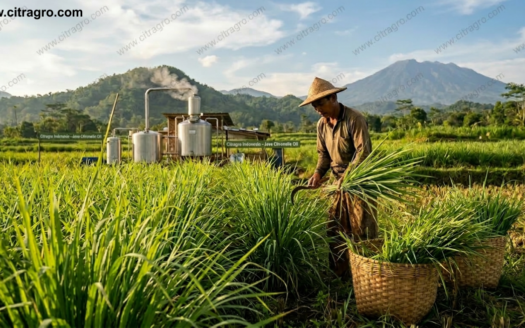
In the early 20th century, the island of Java emerged as the world’s primary epicenter for high-quality essential oils. While many regions produced Cymbopogon, the specific variety known as Winterianus Jowitt—or Java-type Citronella—thrived in Indonesia’s unique volcanic soil and tropical microclimates.
This specific terroir produced an oil with a chemical profile far superior to its competitors. It wasn’t just “oil”; it was a complex cocktail of high-percentage Citronellal and Geraniol, making it the indispensable raw material for the burgeoning perfume houses of Grasse and the industrial soap manufacturers of London and New York. This era cemented Indonesia’s reputation as a reliable source of “liquid gold.”
2. The Chemical Evolution: From Raw Aroma to Molecular Precision
In the past, the industry focused simply on the “smell.” Today, the global market has evolved into a realm of molecular precision. The evolution of the essential oil industry can be broken down into three distinct eras:
- The Artisanal Era: Small-scale traditional stills focusing on local trade.
- The Industrial Boom: Mass production where quantity often outweighed consistent quality.
- The Modern “Purity” Era: Where we stand today. Global buyers now require Gas Chromatography-Mass Spectrometry (GC-MS) reports and ISO-compliant standards.
The market has shifted from buying “Citronella Oil” to buying “Citronella Oil with a minimum of 35% Citronellal.” This shift is where the legacy of Java Gold meets modern science.
3. Geopolitical Shifts and Market Resilience
The essential oil industry has always been a mirror of global stability. From the disruptions of the 20th-century world wars to the modern-day supply chain complexities in the Middle East and Eastern Europe, the demand for Indonesian oils has remained a constant.
However, the “evolution” part of the story lies in risk mitigation. Global manufacturers are no longer just looking for the cheapest price; they are looking for resilient partners who can navigate logistical hurdles and provide a stable supply of “Java Gold” despite global economic fluctuations.
4. The Sustainability Pivot: The New Gold Standard
As we move further into 2026, the definition of “Gold” has changed again. Purity is no longer just about the absence of contaminants; it is about the integrity of the process.
- Traceability: Can the oil be traced back to the specific district in Sumatra or Java?
- Ethics: Were the farmers paid fairly?
- Eco-Footprint: Was the steam distillation powered by renewable biomass or fossil fuels?
Conclusion: Carrying the Torch of Java Gold
The legacy of Java Gold is not a relic of the past; it is a living, breathing standard that Citragro Indonesia continues to uphold. By combining the ancestral richness of Indonesian soil with 21st-century distillation technology, the industry has transitioned from a colonial export to a sophisticated, sustainable, and indispensable pillar of global chemistry.
In the next sections of our series, we will dive deeper into how this historical “Gold” is extracted using our state-of-the-art sustainable methods.
The Sourcing Philosophy: Why Local, Ethical Harvesting Determines the Final Chemical Profile
In the high-stakes world of essential oil exportation, the quality of the final product is decided long before the steam enters the distillation chamber. At Citragro Indonesia, our sourcing philosophy is built on a singular truth: The chemical integrity of an oil is a direct reflection of the life of the plant. To achieve the “Java Gold” standard, we focus on the intersection of Terroir, Harvest Timing, and Ethical Synergy.
1. The Power of “Terroir”: Indonesia’s Volcanic Advantage
Just as fine wine is defined by its vineyard, the therapeutic and industrial value of Citronella and Patchouli is defined by the soil. Indonesia’s position on the “Ring of Fire” provides a mineral-rich, volcanic soil base that is naturally high in potash and organic matter.
- Mineral Bioavailability: The specific mineral composition of Indonesian soil allows plants like Cymbopogon winterianus to synthesize higher concentrations of Citronellal and Geraniol.
- Micro-Climate Adaptation: Our sourcing regions in Sumatra and Java offer the perfect balance of high humidity and distinct dry seasons, which “stresses” the plant just enough to trigger maximum oil production in its leaves as a natural defense mechanism.
2. The Science of Chrono-Harvesting
Ethical sourcing is often misunderstood as merely a social gesture; in reality, it is a technical necessity.
Plants have a biological clock. If Citronella is harvested too early, the oil yield is low and the scent is “green” rather than citrusy. If harvested too late, the plant begins to lignify, reducing the solubility of the precious esters.
- The Golden Hour: We work with local farmers to identify the precise maturity window.
- Manual Precision: Unlike mechanized broad-cutting used in other countries, our local partners often use manual harvesting. This prevents “bruising” the plant material, which can cause premature oxidation of the oil before it even reaches the distillery.
3. Ethical Synergy: The Human Element of Quality
At Citragro Indonesia, we believe that a stressed farmer produces a poor crop. Ethical harvesting means more than just fair wages; it means knowledge transfer.
- Traceability (The “Hulu ke Hilir” Approach): By maintaining direct relationships with farming cooperatives, we can trace every batch of oil back to a specific district. This level of transparency is exactly what modern European and American pharmaceutical buyers demand.
- Sustainable Land Stewardship: We discourage the use of synthetic pesticides which can leave trace residues in the essential oil (Pesticide-Free Guarantee). Instead, we promote polyculture and organic soil management, ensuring the land remains fertile for the next decade of exports.
4. Why This Matters to the Global Buyer
When a global buyer chooses an oil sourced ethically from Citragro Indonesia, they are not just buying a fragrance; they are buying chemical stability.
- Lower Oxidation Rates: Hand-harvested, fresh material leads to a more stable oil with a longer shelf life.
- High Active Compounds: Our sourcing philosophy consistently hits the upper deciles of international ISO standards for active molecular content.
- Compliance Security: Ethical sourcing ensures that your supply chain is free from the risks of environmental degradation or labor disputes, protecting your brand’s reputation.
Conclusion: Purity Starts in the Soil
The “Purity” in our From Plant to Purity promise is rooted in the soil of Indonesia. By respecting the biological needs of the plant and the economic needs of the farmer, Citragro Indonesia ensures that the “Java Gold” we export is as chemically potent as it is ethically sound.
The Science of Steam Distillation: A Step-by-Step Look at Our Extraction Technology
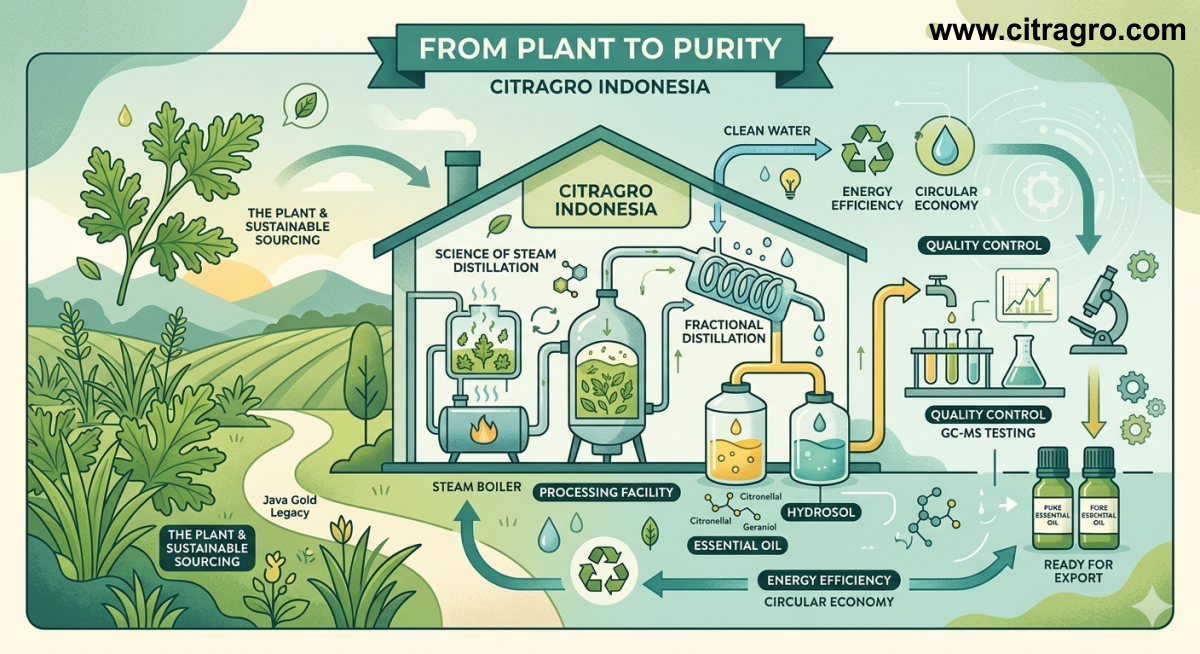
While the quality of “Java Gold” is born in the soil, it is captured in the distillery. At Citragro Indonesia, we view distillation not merely as a heating process, but as a sophisticated separation science. The goal is to isolate volatile aromatic molecules—such as Citronellal, Geraniol, and Patchoulol—without subjecting them to thermal degradation or chemical contamination.
1. Pre-Processing: The Importance of Surface Area
Before the distillation begins, the harvested biomass (such as Citronella leaves or Patchouli stalks) undergoes a controlled wilting or drying process. This is a critical scientific step:
- Cellular Rupture: Controlled drying begins to break down the plant’s glandular trichomes (the tiny “sacks” that hold the oil).
- Moisture Balancing: Reducing excess water content ensures that the steam can penetrate the plant material evenly, preventing “channeling”—a common error where steam bypasses parts of the biomass, leading to inefficient yields.
2. The Mechanics of Steam Injection
We utilize Indirect Steam Distillation. Unlike “water distillation” where the plant sits in boiling water (which can lead to “cooking” or hydrolysis of the oil), our method involves passing dry, saturated steam through the plant material.
- Diffusion & Osmosis: As the steam rises through the distillation vat, it creates a pressure gradient. This causes the essential oil to diffuse from the inner oil glands to the surface of the leaf.
- Azeotropic Evaporation: The oil and water (steam) form an azeotropic mixture, allowing the oil to evaporate at a temperature lower than its actual boiling point. This is vital for preserving the delicate top notes of the fragrance.
3. The Condensation Phase: Rapid Thermal Recovery
Once the steam has carried the oil molecules out of the vat, the mixture enters a high-efficiency stainless steel condenser.
- Heat Exchange: Cold water circulates around the coils, causing the vapor to snap-cool back into a liquid state.
- Preserving the Molecular Profile: The speed of this cooling is essential. If the cooling is too slow, the oil stays in a heated liquid state for too long, which can lead to oxidation and a “burnt” off-note in the final aroma.
4. The Separator (The Florentine Flask)
The final stage of the extraction is the physical separation of oil and water based on Specific Gravity.
- Density Stratification: Since most essential oils (like Citronella) are lighter than water, they rise to the top of the separator.
- Hydrosol Capture: The water that settles at the bottom is not “waste”; it is a nutrient-rich Hydrosol (floral water), often used in the cosmetic industry for toners and mists.
- Vacuum Finishing: At Citragro, we often use a final vacuum filtration step to remove any microscopic moisture particles from the oil, ensuring a shelf-stable, 100% pure anhydrous product.
5. Why Our Technology Wins the Export Market
Many traditional distillers use “fire-under-pot” methods which create “hot spots” and degrade the Geraniol content. Our technology ensures:
- Chemical Consistency: Every batch hits the same molecular markers required by international buyers.
- Energy Efficiency: Our boilers are designed for maximum heat recovery, reducing the carbon footprint per kilogram of oil produced.
- Material Integrity: We use exclusively 316-Grade Stainless Steel to prevent heavy metal contamination, a frequent “red flag” in global laboratory testing.
Conclusion: Engineering Purity
The science of steam distillation at Citragro Indonesia is where nature’s bounty meets industrial rigor. By controlling every variable—from steam pressure to condensation speed—we ensure that the “Java Gold” we ship is not just an oil, but a concentrated essence of Indonesian excellence.
Quality Control & Traceability: Meeting International Standards via GC-MS Testing
In the global essential oil trade, “purity” is not a subjective claim—it is a verifiable chemical reality. At Citragro Indonesia, our Quality Control (QC) protocols are designed to eliminate human error and provide our international partners with absolute certainty. The cornerstone of this certainty is our commitment to Gas Chromatography-Mass Spectrometry (GC-MS) testing and a robust, end-to-end traceability system.
1. The Gold Standard: Understanding GC-MS Analysis
To a layperson, Citronella oil is just a fragrant liquid. To a chemist at Citragro, it is a complex map of hundreds of volatile compounds. We utilize GC-MS testing for every batch to ensure we meet the “Fingerprint” of true Java Gold.
- Gas Chromatography (The Separator): This process vaporizes the oil and passes it through a long column. Different molecules (like Citronellal, Geraniol, and Limonene) move at different speeds, effectively separating the oil into its individual chemical components.
- Mass Spectrometry (The Identifier): As each component emerges, the mass spectrometer “weighs” the molecules and breaks them into fragments. This allows us to identify not only the beneficial compounds but also to detect even the slightest trace of adulterants or synthetic additives.
- Purity Guarantee: If a batch does not hit the minimum percentage of active constituents (e.g., 35% Citronellal for premium grade), it does not leave our facility.
2. Beyond Aroma: Testing for Contaminants
Meeting international standards (such as ISO or AFNOR) requires more than just a high Geraniol count. Our QC lab scans for “invisible” threats that can ruin a formulation:
- Heavy Metal Screening: We ensure zero contamination from Lead, Mercury, or Arsenic, which can sometimes occur in poorly managed artisanal stills.
- Pesticide Residue Analysis: Because we work closely with our farmers on organic practices, our GC-MS reports confirm that our oils are free from harmful agricultural chemicals.
- Specific Gravity & Refractive Index: These physical tests act as a secondary “handshake” to the GC-MS, confirming the oil’s density and purity level.
3. Traceability: The “Farm-to-Freight” Digital Trail
In 2026, transparency is the new currency of the export market. Citragro Indonesia has implemented a Batch-Traceability System that allows a buyer in Rotterdam or New York to know exactly where their oil originated.
- Batch Coding: Every drum of oil is assigned a unique ID linked to its specific distillation date and raw material source.
- The Digital Pedigree: This ID connects the final GC-MS lab report to the harvest records of the specific farming cooperative in Sumatra or Java.
- Risk Mitigation: Traceability ensures that if a client has a specific requirement (e.g., a specific Citronellal-to-Geraniol ratio), we can pinpoint the exact harvest region that consistently produces that profile.
4. Meeting Global Compliance (ISO & Beyond)
Our QC department stays ahead of shifting global regulations, such as REACH (Europe) and IFRA (International Fragrance Association) standards. By providing comprehensive COA (Certificate of Analysis) and MSDS (Material Safety Data Sheets) with every shipment, we reduce the administrative burden on our clients.
We don’t just ship oil; we ship compliance. This reliability is why Citragro is a preferred partner for industrial manufacturers who cannot afford variations in their raw material supply.
Conclusion: Trust Through Science
At Citragro Indonesia, Quality Control is not a final hurdle—it is a continuous thread that runs through our entire operation. By combining the natural heritage of Indonesian botanicals with the cold, hard data of GC-MS testing, we ensure that every liter of oil is a masterpiece of precision and a testament to our “From Plant to Purity” promise.
Circular Economy in Production: Waste Management and Energy Efficiency at the Facility
In the modern essential oil industry, the definition of a “premium” product has shifted. It is no longer enough for an oil to be chemically pure; it must also be ethically and environmentally “clean.” At Citragro Indonesia, we have moved beyond the traditional linear model of Take-Make-Waste. Instead, our facility operates on a Circular Economy framework, where every byproduct is viewed as a secondary resource and every joule of energy is maximized.
1. The Biomass Loop: Turning “Spent Leaves” into Energy
The most significant byproduct of steam distillation is the large volume of “spent” botanical material—the leaves and stalks that remain after the oil has been extracted. In conventional setups, this is often treated as waste that clogs local ecosystems.
- The Bio-Fuel Cycle: At Citragro, we sun-dry the extracted Citronella and Patchouli biomass. Once dried, this material possesses a high caloric value. We feed this biomass back into our high-efficiency boilers.
- Carbon Neutrality Goals: By using the plant’s own waste to generate the steam required for the next distillation batch, we significantly reduce our reliance on fossil fuels like coal or diesel. This creates a self-sustaining energy loop that lowers the carbon footprint of every liter of oil produced.
2. The Hydrosol Harvest: Utilizing “Floral Water”
During the condensation phase of distillation, the steam turns back into water. This water, known as Hydrosol, contains microscopic amounts of essential oil and water-soluble plant components that a separator cannot catch.
- Zero-Waste Aqueous Management: Rather than discharging this water into the local drainage system, we capture and filter it.
- Secondary Markets: Our high-grade Citronella and Patchouli hydrosols are stabilized and sold to the cosmetic and aromatherapy industries as natural toners and base ingredients. This ensures that 100% of the plant’s biological value is utilized.
3. Organic Regeneration: Returning Minerals to the Soil
Not all biomass is burned for fuel. A portion of our spent botanical material is diverted to a composting program.
- Nutrient Recycling: Essential oil extraction only removes the volatile oils; the minerals (Potassium, Nitrogen, Phosphorus) remain in the spent leaves.
- Soil Health: We process this waste into organic mulch and compost, which is then distributed back to our partner farmers. This reduces the need for synthetic chemical fertilizers in the next planting cycle, ensuring the long-term fertility of the Indonesian volcanic soil that produces our “Java Gold.”
4. Advanced Heat Recovery & Water Efficiency
Energy efficiency at Citragro is also a matter of engineering. Our facility utilizes a Closed-Loop Cooling System.
- Water Conservation: The water used in our condensers to cool the steam is not wasted. It circulates through a cooling tower and is reused indefinitely, drastically reducing our groundwater consumption.
- Heat Exchangers: We employ heat exchangers to capture the residual warmth from the outgoing steam to pre-heat the incoming boiler water. This reduces the energy “jump” required to reach boiling point, further optimizing our fuel efficiency.
5. Why Sustainability is a Competitive Advantage
For our global B2B partners, our commitment to a circular economy is a critical part of their Scope 3 Emission reporting. By sourcing from Citragro Indonesia, international buyers can guarantee:
- Reduced Supply Chain Emissions: Our biomass-fueled production is significantly greener than gas- or coal-fired alternatives.
- Compliance with ESG Standards: We provide the documentation necessary for Environmental, Social, and Governance (ESG) audits required by major European and North American retailers.
- Future-Proof Partnerships: As global regulations on industrial waste tighten, our zero-waste facility remains ahead of the curve, ensuring a stable, long-term supply.
Conclusion: A Legacy of Responsibility
At Citragro Indonesia, we believe that the purity of our oil is inseparable from the health of our environment. Our circular economy approach ensures that the “Java Gold” we export doesn’t just benefit the fragrance industry—it sustains the Indonesian landscape and the communities that call it home.
Conclusion: Why Purity is the Ultimate Long-Term Investment for Global Partners
In the fast-moving consumer goods (FMCG) and specialty chemical sectors, the pressure to reduce costs is constant. However, for global manufacturers sourcing essential oils like Citronella and Patchouli, the “cheapest” liter of oil often becomes the most expensive mistake. At Citragro Indonesia, we have observed that purity is not a luxury—it is the ultimate strategic investment that ensures long-term profitability, brand safety, and supply chain resilience.
1. The Hidden Costs of Adulteration
In the essential oil trade, adulteration (the stretching of pure oil with synthetic chemicals or cheaper vegetable oils) is a persistent challenge. While an adulterated oil may pass a basic “smell test,” it creates catastrophic downstream effects for a global brand:
- Formulation Instability: Synthetic additives can cause unforeseen chemical reactions in perfumes or lotions, leading to separation, discoloration, or altered scents over time.
- Regulatory Fines: With increasingly sensitive testing by customs and health authorities in Europe (REACH) and North America (FDA), a single “dirty” batch can lead to massive fines and the blacklisting of a brand.
- Investment Protection: By sourcing 100% pure “Java Gold” from Citragro, partners eliminate the hidden costs of product recalls and reformulation.
2. Consistency: The Key to Industrial Scalability
For a global partner, the biggest risk is not price—it is variability. If the Citronellal content of an oil fluctuates by 10% between shipments, the final product’s efficacy changes.
- Predictable Batching: Our “From Plant to Purity” process ensures that the chemical fingerprint of our oil remains consistent year-round.
- Reduced Quality Assurance (QA) Overhead: When a supplier like Citragro consistently hits ISO standards, the buyer spends less time and money on re-testing and more time on innovation.
3. ESG as a Brand Asset
In 2026, the value of a product is tied to its “Ethical Pedigree.” Consumers are no longer just buying a scent; they are buying the story of the Indonesian farmer and the zero-waste distillery.
- Future-Proofing: Global regulations on Environmental, Social, and Governance (ESG) reporting are tightening. Investing in Citragro’s sustainable distillation process means your supply chain is already compliant with tomorrow’s laws.
- Brand Loyalty: Transparency in the “Plant to Purity” journey provides marketing departments with powerful, authentic stories that resonate with the modern, eco-conscious consumer.
4. Stability in Geopolitical Volatility
As global supply chains face disruptions—from Middle Eastern logistics challenges to shifting trade policies—having a direct, transparent relationship with a producer like Citragro Indonesia provides a “buffer of trust.”
- Direct Sourcing: By cutting out unnecessary middlemen, our partners gain direct insight into the harvest and production status.
- Long-Term Partnership: We don’t view our clients as one-time buyers, but as long-term collaborators. Our investment in distillation technology is an investment in your company’s ability to stay stocked with premium raw materials, regardless of market fluctuations.
Final Summary: The Citragro Promise
The journey from an Indonesian serai wangi leaf to a high-purity essential oil is a complex one. It requires the perfect soil, ethical harvesting, scientific distillation, and rigorous laboratory validation.
Choosing Citragro Indonesia means choosing a partner who understands that purity is the only path to sustainability. In the global market of 2026 and beyond, “Java Gold” is not just about the richness of the aroma—it is about the integrity of the partnership.
Your Gateway to Indonesian Excellence
The “Java Gold” of the future is built on a foundation of trust, transparency, and technology. Whether you are looking for premium raw materials or a strategic foothold in the Indonesian market, we provide the expertise to help you succeed.
1. Premium Indonesian Essential Oil Exports
Secure a stable, high-purity supply of Indonesian natural products for your industrial needs. From Citronella to Patchouli, we ensure every drop meets the highest global standards.
- Verified Quality: Full GC-MS analysis and COA provided with every shipment.
- Sustainable Partnerships: Direct-from-source sourcing that supports local communities.
- Global Distribution: Expert logistics for seamless export to any continent.
🌐 Product Information: www.citragro.com 📧 Inquiries: citragro@gmail.com
2. Strategic Business & Property Consulting
Navigating the Indonesian B2B landscape requires more than just capital—it requires local intelligence. For international investors looking to expand or secure high-value property assets in Indonesia, Yonathan Chen offers bespoke consulting services.
- Market Entry Strategy: Expert guidance on regulations and industrial trends.
- Property Investment: Identifying prime commercial and industrial opportunities in Indonesia.
- Strategic Growth: Tailored solutions for long-term business success in Southeast Asia.
🌐 Consulting Services: www.yonathanchen.com