
The Citronellal Secret: Why Indonesia’s Java Citronella Outshines Global Competitors
The Liquid Gold of Southeast Asia: Unveiling the Legacy of Cymbopogon Winterianus
In the vast landscape of global commodities, few substances carry as much historical weight and aromatic power as the essential oil derived from Cymbopogon winterianus, more commonly known as Java Citronella. Often referred to by industry insiders as the “Liquid Gold of Southeast Asia,” this potent botanical extract is not merely an agricultural product; it is a cornerstone of Indonesia’s aromatic identity and a vital engine for the global fragrance and pharmaceutical sectors.
A Botanical Masterpiece: Understanding Cymbopogon Winterianus
While there are many species of citronella grass, the winterianus variety (or Maha Pengiri) is the undisputed king of the genus. Unlike its cousin, Cymbopogon nardus (Ceylon type), which produces a lower-grade oil, the Java type is a high-yielding perennial grass that thrives in the humid, tropical corridors of the Indonesian archipelago.
Characterized by its long, slender leaves and robust root system, this plant acts as a natural laboratory. It synthesizes complex aldehydes and alcohols—most notably citronellal and geraniol—at concentrations that are biologically superior to those grown in any other climate. This biological efficiency is what makes Indonesian Java Citronella the preferred raw material for sophisticated chemical isolation and high-end perfumery.
The Historical Ascent: From Colonial Roots to Global Dominance
The history of Indonesia’s dominance in the essential oil market is a saga of geographical advantage meeting human expertise. For over a century, the islands of Java and Sumatra have been the epicenter of “Atsiri” (essential oil) production.
- The Dutch Era Innovation: During the late 19th and early 20th centuries, it was the specific soil conditions of Java that led researchers to identify the winterianus species as the superior variety for industrial distillation.
- Post-War Global Monopoly: By the mid-20th century, Indonesia had solidified its position, supplying more than 70% of the world’s citronella oil. Even as competitors emerged in Latin America and mainland Asia, the “Java” label remained the global benchmark for purity.
- Modern Strategic Importance: Today, in 2026, as the world shifts toward “Green Chemistry” and sustainable, plant-based ingredients, Indonesia’s role has transitioned from a simple supplier to a strategic partner. The Indonesian essential oil industry is no longer just about raw extraction; it is about providing the high-purity molecules that drive the next generation of eco-friendly insect repellents, aromatherapeutics, and fine fragrances.
Indonesia’s Enduring Competitive Edge
What keeps Indonesia at the top of the global hierarchy? It is the intersection of heritage and terroir. The archipelago provides a unique “volcanic micro-climate” where the soil’s mineral content acts as a natural fertilizer, pushing the plant’s citronellal synthesis to its genetic limit.
Furthermore, generations of Indonesian distillers have refined the art of steam distillation. This traditional wisdom, now merging with modern vacuum distillation technologies, ensures that the delicate aromatic molecules are preserved, preventing the “burnt” or “grassy” notes often found in lower-quality oils from global competitors.
Conclusion: More Than Just a Scent
As we look at the current market dynamics, “The Liquid Gold of Southeast Asia” represents more than just a citrusy scent. It represents a resilient agricultural heritage and a biological secret that remains locked within the Indonesian soil. For the global buyer, Java Citronella is the ultimate assurance of quality, proving that while many can grow the grass, only Indonesia can produce the gold.
The Chemical Blueprint: Dominating Citronellal and Geraniol Levels
In the world of high-purity essential oils, sensory appeal is only half the story. The true value of an oil is written in its gas chromatography (GC) report. For Java Citronella, the “Chemical Blueprint” is defined by two powerhouse molecules: Citronellal and Geraniol. It is in the concentration and ratio of these specific compounds that Indonesia’s production creates a massive gap between itself and global competitors.
The Molecular Core: A Scientific Breakdown
Java Citronella (Cymbopogon winterianus) is prized over other species primarily because it is a “high-aldehyde” oil. Its chemical profile is a complex matrix of over 80 constituents, but the industry focuses on the “Big Three”:
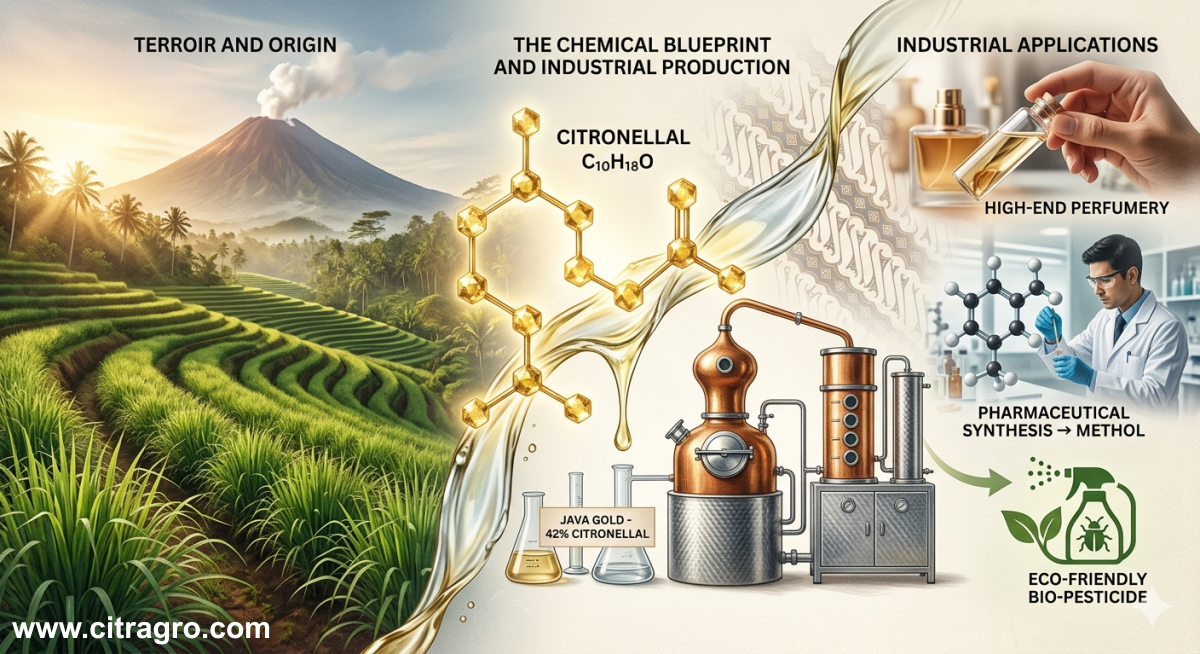
- Citronellal ($C_{10}H_{18}O$): This acyclic monoterpenoid aldehyde is the soul of the oil. It provides the signature lemon-like, rosy scent and serves as the primary active ingredient for natural insect repellents. More importantly, it is the raw precursor used to synthesize Hydroxycitronellal, a vital ingredient in fine floral perfumery.
- Geraniol ($C_{10}H_{18}O$): A monoterpenoid alcohol with a sweet, rose-like odor. High geraniol content is what gives Java Citronella its “premium” olfactory roundness, preventing the oil from smelling overly “grassy” or “harsh.”
- Citronellol ($C_{10}H_{20}O$): Often grouped with geraniol as “total alcohols,” this compound adds a waxy, floral depth and enhances the oil’s stability in cosmetic formulations.
Indonesia’s “Golden Ratio” vs. International Benchmarks
The international market, governed by standards such as ISO 3848, sets minimum requirements for citronella oil. However, Indonesian Java Citronella consistently outperforms these baseline metrics, creating what traders call “The Java Premium.”
| Chemical Component | International Standard (ISO) | Indonesian “Java Gold” Typical Analysis |
| Citronellal | Min. 30% – 35% | 35% – 45%+ |
| Geraniol | Min. 18% – 20% | 20% – 25%+ |
| Citronellol | Min. 8% – 10% | 10% – 15% |
| Total Alcohols | Min. 85% | 88% – 93% |
While oils from China or Vietnam often struggle to hit the 35% Citronellal mark without significant “rectification” (post-processing), Indonesian crude oil frequently exits the local still already exceeding these levels. This high natural purity means less processing is required, preserving the delicate “top notes” that industrial buyers crave.
Why “Total Alcohols” Matter for the Global Market
In industrial B2B procurement, buyers look at the Total Acetylizable Alcohol (TAA). Indonesia’s Java Citronella boasts a TAA that rarely dips below 85%, often reaching 92%.
For a pharmaceutical or fragrance chemist, a higher TAA means a higher yield of isolates. If a factory is processing 1,000 liters of oil to extract pure Geraniol, the Indonesian blueprint provides a significantly higher ROI (Return on Investment) compared to lower-grade oils from other regions. This efficiency is exactly why global giants in the flavor and fragrance (F&F) industry maintain long-term contracts with Indonesian distillers.
The Stability Factor: The “Clean” Distillation
The chemical blueprint is not just about the amount of citronellal; it is about the absence of impurities. Indonesian distillation techniques have evolved to minimize the presence of “heavy” sesquiterpenes and “burnt” nitrogenous compounds. The result is a “clean” blueprint—an oil that remains chemically stable for longer periods and integrates seamlessly into complex luxury formulas without causing discoloration or separation.
Conclusion: A Masterclass in Natural Chemistry
The superiority of Indonesia’s Java Citronella is not a marketing myth; it is a laboratory-proven reality. By consistently delivering a chemical profile that exceeds international benchmarks, Indonesia ensures that its “Liquid Gold” remains the indispensable foundation of the global essential oil industry.
Terroir and Climate: The Geographical Unfair Advantage
In the world of viticulture, the term terroir refers to the environmental factors—soil, climate, and sunlight—that give a wine its unique character. The same principle applies to essential oils. While the seeds of Cymbopogon winterianus can be planted anywhere in the tropics, the resulting oil only achieves its “Gold Standard” status when grown in the specific cradle of the Indonesian archipelago. This is Indonesia’s “Geographical Unfair Advantage.”
1. The Volcanic Catalyst: Mineral-Rich Foundations
Indonesia is situated on the “Ring of Fire,” a high-activity tectonic zone that has gifted the islands with some of the most fertile volcanic soil on Earth. For Java Citronella, this soil is the primary engine of its high chemical potency.
- Micro-Nutrient Density: Volcanic ash is rich in magnesium, potassium, and phosphorus. These minerals act as natural catalysts in the plant’s metabolic pathways, specifically the Mevalonate pathway, which is responsible for the synthesis of terpenes like Citronellal and Geraniol.
- Soil Porosity and Drainage: Citronella grass requires deep hydration but hates “wet feet” (root rot). The loamy, porous nature of Indonesian volcanic soil allows for rapid drainage while retaining deep-earth moisture, forcing the plant to concentrate its essential oils in the leaves rather than dissipating energy into excessive water storage.
2. Equatorial Photoperiod: The Power of 12-Hour Sunlight
Located directly on the Equator, Indonesia enjoys a remarkably stable photoperiod. Unlike competitors in higher latitudes (such as Southern China or Brazil), where day length fluctuates significantly with the seasons, Indonesian crops receive consistent, high-intensity UV radiation year-round.
- Photosynthetic Efficiency: Constant 12-hour sunlight ensures that the plant is in a state of “peak production” every single day. This stability prevents the “chemical dips” seen in other regions during winter months.
- UV Stress and Oil Production: High UV exposure at the Equator acts as a mild environmental stressor. In response, the Cymbopogon plant produces higher concentrations of essential oils—specifically aldehydes—to protect its leaf tissues from oxidation. This natural defense mechanism is exactly what creates the high-percentage Citronellal sought by global buyers.
3. The “Seed vs. Soil” Paradox: Why Relocation Fails
One of the most fascinating phenomena in the essential oil industry is the failure of “relocated” Java Citronella. Historically, seeds and cuttings from high-performing Indonesian plants have been exported to Vietnam, Africa, and South America in an attempt to replicate the Java profile.
The results are almost always disappointing. Within two to three generations of planting elsewhere:
- Chemical Drift: The Citronellal content typically drops from the Indonesian average of 40% down to 25%–30%.
- Aromatic Thinning: The oil loses its “floral roundness” (Geraniol) and takes on a “harsh, grassy” or “camphoraceous” odor profile.
This proves that the quality of Java Citronella is not merely genetic; it is a biochemical dialogue between the plant and the Indonesian environment. Without the specific mineral balance of the Java-Sumatra volcanic arc and the precise humidity of the Indonesian tropics, the plant simply does not “express” its full aromatic potential.
Conclusion: An Unreplicable Masterpiece
The superiority of Indonesia’s Citronella is not a result of human intervention alone, but a gift of geography. The combination of mineral-rich volcanic earth and relentless equatorial sun creates a natural “bioreactor” that no other region on Earth can currently match. For global manufacturers, this means that while Citronella can be grown anywhere, Java Citronella—in its true, high-potency form—can only be born in Indonesia.
Java Citronella vs. Global Competitors (China, Vietnam, Brazil)
In the global essential oil market of 2026, the demand for Java Citronella (Cymbopogon winterianus) has reached new heights, driven by the shift toward natural, bio-based insect repellents and fragrance precursors. While Indonesia is the historical heart of this industry, it is not the only player. Countries like China, Vietnam, and Brazil have established significant production bases. However, a closer look at the data—specifically in terms of purity, aroma intensity, and consistency—reveals why Indonesian oil remains the undisputed “Gold Standard.”
1. The Production Powerhouse: Indonesia vs. China
China is often Indonesia’s most formidable competitor, primarily due to its massive scale and lower cost basis. However, the two nations occupy different segments of the value chain.
- Market Share: As of 2026, Indonesia produces approximately 41% of the world’s Java-grade citronella oil, with China following at roughly 30%.
- The Quality Gap: While China excels in volume, its oil often undergoes heavy “rectification” (industrial processing) to meet international standards. Indonesian oil, by contrast, frequently exits the primary distillation process with a Citronellal content of 35%–45%, whereas Chinese samples often hover near the lower ISO threshold of 30%–34% unless chemically concentrated.
2. Aroma Intensity: The Olfactory Edge
Aroma intensity is a critical metric for the fragrance and daily chemical industries (soaps, detergents, and candles).
- Indonesian Profile: Due to the “terroir” factors of volcanic soil and equatorial sun, Indonesian Java Citronella possesses a “full-bodied” and “round” citrus aroma with subtle floral undertones.
- Competitor Profiles (Vietnam & Brazil): Oils from Vietnam and Brazil are often characterized by a “thinner” or more “grassy” scent profile. This is often due to the higher presence of unwanted terpenes that dilute the primary Citronellal/Geraniol impact. In blind olfactory tests, perfumers consistently choose Indonesian Java oil for its ability to “cut through” other ingredients in a complex formula.
3. Purity and Chemical Consistency
For B2B buyers in the pharmaceutical sector—where Citronella is used to synthesize Menthol—consistency is more important than price.
- The Consistency Challenge: Recent 2026 market reports indicate that nearly 23% of global producers struggle with batch-to-batch consistency.
- The Indonesian Advantage: Because Indonesia has established “Atsiri” clusters (specialized production zones like West Java), the distillation techniques are highly standardized. Indonesian exporters, such as Citragro Indonesia, have moved toward sophisticated testing (GC-MS) at the source, ensuring that every shipment meets the high Total Acetylizable Alcohol (TAA) threshold of 85%–92%.
Comparative Summary: Java Citronella at a Glance
| Feature | Indonesia (Java Gold) | China | Vietnam / Brazil |
| Typical Citronellal | 35% – 48% | 30% – 35% | 28% – 33% |
| Primary Use | Fine Fragrance & Pharma | Mass-Market Soap/Detergent | Local Industrial Use |
| Aroma Quality | Sweet, Citrus, Floral | Sharp, Grassy | Sharp, Camphoraceous |
| Purity Basis | Natural high-yield | Often rectified/blended | Variable |
4. The 2026 Economic Reality: Why Purity Wins
While Brazil and Vietnam have attempted to capture market share through aggressive pricing, the “rectification cost” (the cost to clean and concentrate lower-grade oil) has become a burden for global buyers. In an era where “Direct-from-Source” transparency is valued, Indonesian oil offers the highest Natural Purity ROI. Manufacturers prefer to buy a premium Indonesian oil that requires less processing than a cheaper oil that needs expensive laboratory refinement to reach functional standards.
Conclusion: The Enduring Premium
The competitive landscape of 2026 confirms a singular truth: volume is not value. While other nations can grow citronella grass, Indonesia produces Citronella Oil. By maintaining a superior chemical blueprint and an unmatched olfactory profile, Indonesian Java Citronella continues to outshine its global competitors, proving that in the world of essential oils, the “Java” label is the ultimate competitive advantage.
Industrial Applications: Beyond the Scent
While many consumers associate Citronella primarily with outdoor candles and traditional remedies, the global industrial reality of 2026 is far more sophisticated. Because of its high Citronellal and Geraniol content, Indonesia’s Java Citronella is a foundational “building block” in organic chemistry. It is not just an oil; it is a feedstock for some of the most advanced products in the fragrance, medical, and agricultural sectors.
1. High-End Perfumery: The “Secret” Top Note
In the luxury fragrance world, Java Citronella is rarely the “star” of the show, but it is frequently the “secret” behind a scent’s vibrancy.
- The Isolates Advantage: Master perfumers in Grasse, France, do not use crude citronella oil in fine perfumes. Instead, they use Indonesian oil to isolate Geraniol and Citronellol. These isolates provide a clean, rosy, and sweet floral backbone for iconic floral fragrances.
- Modern Citrus Accords: In 2026, the trend for “Natural & Transparent” fragrances has seen a resurgence in using high-purity Java Citronella as a top note. Its ability to provide a bright, citrusy lift without the phototoxicity (skin sensitivity) of some cold-pressed citrus oils makes it an indispensable tool for luxury scent formulators.
2. Pharmaceutical Synthesis: The Precursor to Menthol
Perhaps the most significant industrial use of Java Citronella is in the pharmaceutical industry. The oil is a primary natural precursor for the synthesis of L-Menthol.
- The Citronellal-to-Menthol Pipeline: Through a process of catalytic hydrogenation and cyclization, the high Citronellal content (35%–45%) of Indonesian oil is converted into high-purity menthol.
- Global Demand: As the world moves away from synthetic coal-tar based chemicals, the demand for “Plant-Based Menthol” has surged. Indonesia’s ability to provide a consistent, high-yield chemical blueprint ensures that it remains the preferred source for pharmaceutical giants producing everything from cough suppressants to topical analgesics and oral care products.
3. Eco-Friendly Pesticides: The Green Revolution
As global regulations—particularly in the EU and North America—tighten around synthetic chemical pesticides (like DEET), Java Citronella has emerged as the hero of “Green Chemistry.”
- Bio-Pesticide Potency: Citronellal acts as a potent repellent by interfering with the olfactory receptors of insects. Unlike synthetic alternatives, it is non-toxic to humans and biodegradable.
- Agricultural Synergy: Beyond household mosquito sprays, high-grade Indonesian oil is being integrated into large-scale agricultural “bio-pesticides.” These products protect food crops from pests without leaving toxic residues in the soil or groundwater, aligning perfectly with the 2026 global mandate for sustainable farming.
4. Aromatherapy and Holistic Wellness
In the wellness sector, the “Java Gold” profile is prized for its high Geraniol content, which is linked to anti-inflammatory and antifungal properties.
- Purity Matters: In clinical aromatherapy, the presence of heavy metals or synthetic adulterants (common in lower-grade oils from other regions) can be dangerous. The “clean” distillation characteristic of Indonesian Java Citronella ensures a therapeutic-grade product that meets the stringent safety standards of the global wellness market.
Conclusion: A Multi-Functional Global Asset
The industrial applications of Indonesia’s Java Citronella extend far beyond the garden candle. From the laboratory of a French perfumer to the manufacturing plant of a global pharmaceutical firm, the “Chemical Blueprint” of this Indonesian treasure is working behind the scenes. Its unique ability to serve as both a finished aromatic product and a high-yield chemical precursor is exactly why it remains Southeast Asia’s most valuable “Liquid Gold.”
This final installment serves as the strategic synthesis of our series. It looks toward the horizon of 2026 and beyond, framing Indonesian Java Citronella not just as a heritage product, but as a high-tech, sustainable solution for the modern global economy.
Conclusion: The Future of Indonesian Citronella Exports
As we navigate the complexities of the global market in 2026, it is clear that the story of Java Citronella is entering a sophisticated new chapter. What began as a traditional “Atsiri” trade has transformed into a strategic cornerstone of the “Green Chemistry” revolution. For Indonesia, the future of Citronella exports is no longer defined by volume alone, but by traceability, technological integration, and sustainable leadership.
1. The Shift to “Green Chemistry” and Bio-Based Solutions
The global regulatory landscape—led by the European Union’s Green Deal and various North American sustainability mandates—is aggressively phasing out synthetic chemicals in consumer goods. This presents a massive “market gap” that Indonesia is perfectly positioned to fill.
- Synthetic Replacement: As industries move away from petroleum-derived aromatics, the high-purity Citronellal and Geraniol from Java Citronella are becoming the “clean” alternatives for everything from luxury soaps to household cleaners.
- The “Zero-Waste” Distillation: The future of Indonesian exports lies in the circular economy. Modern Indonesian distilleries are now exploring the use of spent citronella grass (the biomass left after distillation) as organic mulch or even as a source for cellulose-based packaging, adding a “sustainability premium” to the exported oil.
2. Digital Traceability: From Farm to Fragrance
In 2026, global B2B buyers—from pharmaceutical giants to boutique perfumeries—demand more than just a Certificate of Analysis (CoA). They demand a story of origin.
- Blockchain & QR Integration: The future of the Indonesian export sector is digital. Leading exporters are implementing “Farm-to-Bottle” traceability. By scanning a QR code on a drum of oil, a buyer in New York or Paris can now verify the specific harvest date, the GPS coordinates of the volcanic hillside where it grew, and the precise GC-MS (Gas Chromatography-Mass Spectrometry) profile of that batch.
- The “Java Gold” Branding: By standardizing these digital credentials, Indonesia is successfully branding its oil as a “Geographical Indication” (GI) product, similar to Champagne or Scotch Whisky, ensuring that the “Java” name remains a protected hallmark of quality.
3. Overcoming Global Logistical and Geopolitical Challenges
The export landscape of 2026 has been marked by shifting trade routes and logistical hurdles. However, Indonesia’s strategic location and neutral trade stance have allowed it to maintain a stable supply chain to both Western and Eastern markets.
- Strategic Buffering: To counter global supply chain volatility, Indonesian exporters have invested in state-of-the-art storage facilities that preserve the delicate chemical blueprint of the oil for longer periods, allowing for a steady “buffer” against market fluctuations.
- Emerging Markets: While Europe remains a top destination, the rise of the middle class in India and Southeast Asia has created a new, massive demand for high-quality personal care products—all of which require the vibrant, clean profile of Java Citronella.
4. The Final Verdict: Why Indonesia Wins
The “Citronellal Secret” is ultimately a story of resilience. While other nations may attempt to compete on price, they cannot compete with the Indonesian Terroir or the centuries of distillation expertise embedded in the local culture.
As we look forward, the “Liquid Gold of Southeast Asia” is set to remain Indonesia’s most potent aromatic export. By combining its natural geographical unfair advantage with 21st-century transparency and technology, Indonesia is not just participating in the essential oil market—it is leading it.
Summary of the “Java Gold” Series
Through this deep-dive series, we have explored:
- The History: The legacy of the “Liquid Gold.”
- The Science: The superior chemical blueprint of Citronellal and Geraniol.
- The Earth: The volcanic terroir that cannot be replicated.
- The Competition: Why Indonesia outshines global rivals.
- The Utility: The diverse industrial applications from pharma to perfume.
Final Thought: For the global buyer seeking the pinnacle of purity and performance, the choice is clear: The future is Java. The future is Indonesia.
The Strategic Partnership: Securing Your Supply of “Java Gold”
As the global market for natural ingredients accelerates toward 2030, the window for securing high-purity, sustainably sourced Java Citronella is narrowing. With synthetic alternatives being phased out by international regulations, the “Citronellal Secret” of Indonesia is no longer a secret—it is a global requirement.
To thrive in this evolving landscape, international buyers and industrial formulators need more than just a supplier; they need a strategic partner who understands the intersection of agricultural excellence, global logistics, and market intelligence.
1. Citragro Indonesia: Your Direct Gateway to Purity
At the heart of Indonesia’s essential oil revolution is Citragro Indonesia. We don’t just export oil; we curate a botanical legacy. By leveraging the unique volcanic terroir of the archipelago and state-of-the-art steam distillation, we provide the global market with Citronella oil that consistently hits the “Golden Ratio” of 35%–45% Citronellal.
- Why Partner with Citragro?
- Batch-to-Batch Consistency: Rigorous GC-MS testing ensures your formulation never varies.
- Direct Sourcing: Removing the middleman to provide the highest Natural Purity ROI.
- Scalable Logistics: Experienced in navigating the 2026 global supply chain challenges to ensure your production line never stops.
Take Action for Your Product Line: Explore our full catalog of premium Indonesian natural products, including Citronella, Clove, and Patchouli oils. 🌐 Visit our Digital Export Hub:www.citragro.com✉️ Direct Inquiry/Quotations:citragro@gmail.com
2. Strategic Insight: Business and Asset Optimization
The essential oil trade is only one facet of Indonesia’s booming economy. For investors and entrepreneurs looking to establish a deeper footprint in Southeast Asia—whether through agricultural land acquisition, processing facilities, or strategic market entry—expert guidance is essential.
Navigating the Indonesian regulatory environment and property market requires a consultant who speaks the language of global business and local reality.
- Business & Property Consultation Services:
- Market Entry Strategy: Identifying gaps in the Indonesian export-import sector.
- Asset & Property Management: Securing the right infrastructure for your Indonesian operations.
- Logistical Consulting: Optimizing your supply chain from the “Ring of Fire” to the global stage.
Consult with an Expert: Align your business goals with Indonesia’s growth trajectory. 🌐 Portfolio & Services:www.yonathanchen.com
Final Conclusion: The Choice is Yours
The “Liquid Gold” of Indonesia is ready to power your next innovation. Whether you are a perfumer in Paris seeking the perfect top note, a pharmaceutical firm in Tokyo synthesizing menthol, or an investor looking for the next big opportunity in Southeast Asian commodities—the foundation of your success starts here.
Don’t just observe the market—dominate it with Java Gold.