
Why Indonesia Produces the World’s Best Citronella Oil: The Java Citronella Standard
Introduction: The Unseen Force Behind the Global Scent Industry
For decades, the global fragrance and aromatherapy markets have relied on a silent powerhouse tucked away in the Southeast Asian archipelago. While consumers often associate luxury perfumes with the rolling hills of Grasse, France, the raw olfactory “DNA” of those scents often begins in the volcanic soil of Indonesia. Today, Indonesia is no longer just a participant in the market; it has solidified its position as the “hidden giant” of the global essential oil industry, accounting for a staggering percentage of the world’s supply of patchouli, clove, and most notably, Citronella.
The Prestige of “Java Citronella Oil”
In the world of botanical extracts, not all oils are created equal. Just as “Champagne” is a protected designation for quality in wine, the term “Java Citronella Oil” (Cymbopogon winterianus) has become a global gold standard for excellence.
Originally developed on the island of Java, this specific variety is distinct from its cousin, the Ceylon type found in Sri Lanka. The prestige of Java Citronella lies in its high concentration of Citronellal and Geraniol—the two primary chemical constituents that define its value.
- Premium Perfumery: High-end fragrance houses prefer the Java type because it offers a cleaner, more lemony, and floral profile, making it a versatile top note in sophisticated perfumes.
- Aromatherapy: Its potency ensures a stronger therapeutic effect, widely sought after for its calming properties and natural insect-repelling capabilities without the harsh chemical undertones found in synthetic alternatives.
Vision 2026: Indonesia’s Trajectory in the Bio-Chemical Era
As we move through 2026, the global bio-chemical industry is undergoing a massive shift toward “Green Chemistry.” Consumers are demanding transparency and natural origins, placing Indonesia in an enviable strategic position.
Currently, Indonesia dominates the global market share for Citronella oil, but the vision for 2026 goes beyond raw exports. The country is rapidly transitioning from a raw material provider to a high-tech processing hub. With advancements in fractionated distillation and sustainable farming practices, Indonesia is now providing “Isolates”—refined components used in pharmaceuticals and high-tech bio-pesticides.
This trajectory ensures that Indonesia isn’t just feeding the world’s supply chain; it is leading the innovation of how essential oils are used in the modern, eco-conscious economy. From the misty highlands of Sumatra to the fertile plains of Java, the “liquid gold” of Indonesia continues to be the invisible thread weaving through the world’s most iconic scents and wellness products.
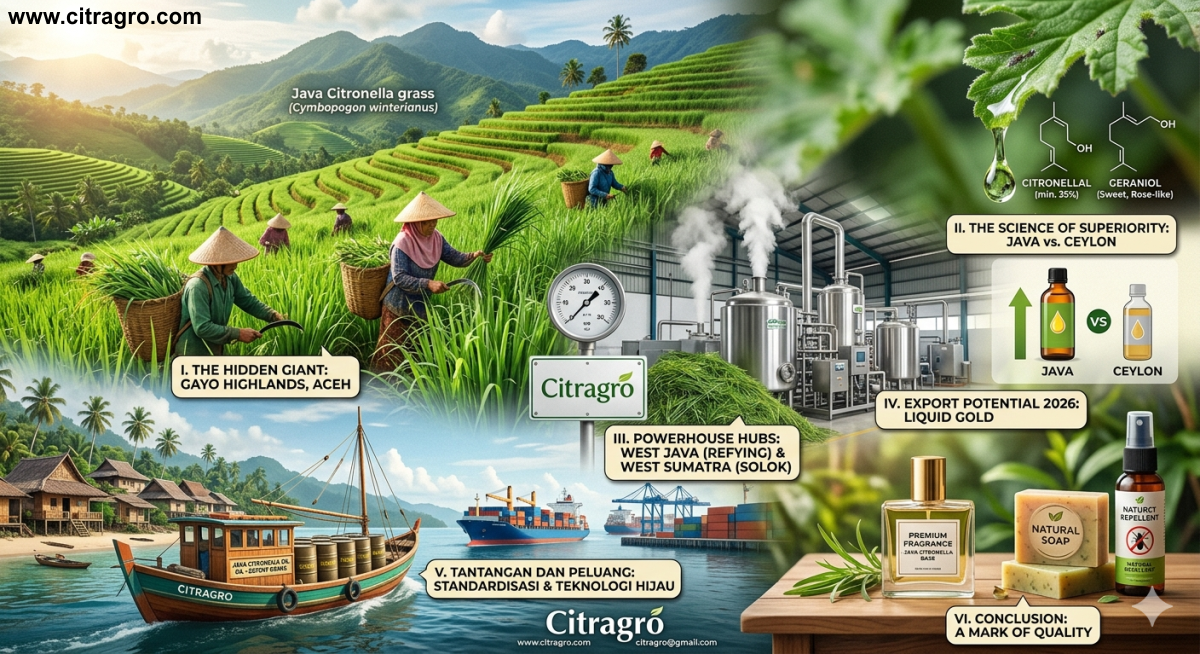
I. The Science of Superiority: Java vs. Ceylon
In the world of essential oils, the name “Citronella” is often used as a broad category, but for industry professionals, there is a clear and definitive hierarchy. At the top of this hierarchy sits the Java Type (Cymbopogon winterianus), which has largely superseded the traditional Ceylon Type (Cymbopogon nardus) in commercial value. The reason for this dominance is not merely a matter of marketing; it is rooted in rigorous chemical science, unique environmental factors, and a commitment to processing excellence.
The Chemical Profile: A Higher Standard of Purity
The true value of Citronella oil is measured by its “Total Geraniol” and “Citronellal” content. While Ceylon oil typically contains only 7% to 15% Citronellal, the Indonesian Java Citronella Oil is a powerhouse, boasting a minimum of 35% Citronellal, with premium batches often reaching much higher.
- Citronellal: This is the aldehyde responsible for the characteristic “lemon-like” scent and the oil’s potent insect-repellent properties. Indonesia’s high concentrations make its oil far more efficient for industrial use.
- Geraniol: Acting as a primary alcohol, Geraniol provides the sweet, floral rose-like undertones. The synergy between high Citronellal and Geraniol in Java oil creates a sophisticated aromatic profile that is indispensable for luxury soaps, detergents, and fine fragrances.
Because Indonesian oil is so concentrated, manufacturers can use smaller volumes to achieve a more powerful aromatic and functional result, making it the most cost-effective and premium choice for B2B buyers worldwide.
The Terroir Factor: Volcanic Soil and Tropical Intensity
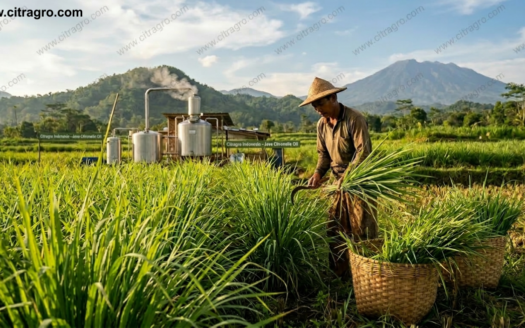
Just as a fine wine is shaped by the vineyard’s soil, the quality of Indonesian Citronella is a product of its terroir. Indonesia’s position along the “Ring of Fire” provides it with exceptionally nutrient-rich volcanic soil. This soil, packed with minerals and organic matter, allows the Cymbopogon winterianus plant to thrive and produce a more complex secondary metabolite profile.
The humid tropical climate of the Indonesian archipelago provides the perfect “pressure cooker” environment:
- High Humidity: Prevents the plant from drying out, ensuring the essential oil glands remain plump and full.
- Consistent Sunlight: Drives the photosynthesis required for high oil synthesis.
- Optimal Rainfall: Distributes nutrients evenly throughout the root systems in regions like Aceh and West Java.
This combination of soil and sky creates a “potent and complex” aromatic profile that simply cannot be replicated in the drier or less mineral-dense regions where Ceylon varieties are traditionally grown.
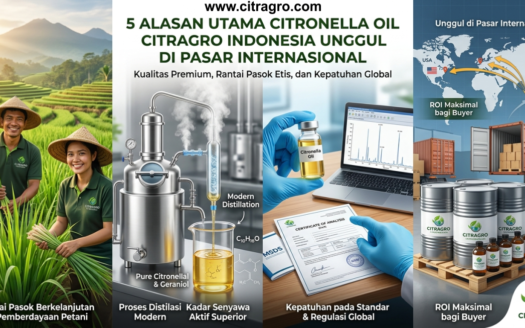
Distillation Excellence: From Tradition to Tech
The final piece of the superiority puzzle is how the oil is extracted. For generations, Indonesian farmers relied on traditional fire-heated distillation. While romantic, these methods often led to “burnt” notes or inconsistent chemical yields due to fluctuating temperatures.
Today, the industry has undergone a massive shift toward modern, eco-friendly steam distillation. By using controlled steam injection, producers can extract the delicate oils at precise temperatures, ensuring that the Citronellal and Geraniol molecules remain intact and uncompromised.
Furthermore, many modern distilleries in Indonesia are moving toward a circular economy model:
- Waste-to-Energy: The spent Citronella grass (the biomass left over after distillation) is dried and used as fuel to power the boilers, significantly reducing the carbon footprint.
- Stainless Steel Standards: The transition to high-grade stainless steel equipment prevents metallic contamination, ensuring the “water-white” to pale yellow clarity that international buyers demand.
Through this marriage of nature’s bounty and scientific precision, Indonesia has ensured that its Citronella oil remains the undisputed benchmark for quality on the global stage.
II. The Powerhouse Regions: Indonesia’s Citronella Hubs
Indonesia’s status as a global leader in Citronella production is not concentrated in a single location. Instead, it is the result of a diverse geographical network where each region plays a specialized role. From the sprawling highlands of Sumatra to the industrial centers of Java, these hubs form the backbone of a supply chain that meets over 60% of global demand.
Gayo Lues, Aceh: The High-Yield Giant
Located in the rugged Gayo Highlands of Northern Sumatra, Gayo Lues is arguably the most critical region for raw volume in the Citronella industry. Known as the “Citronella Capital” of Indonesia, the district boasts tens of thousands of hectares dedicated to Cymbopogon winterianus.
- Massive Scale: In 2026, Gayo Lues continues to lead with the largest cultivation area in the country. The region’s high altitude (200–1,400 meters above sea level) and unique agroforestry patterns—where citronella is often grown alongside pine stands—contribute to exceptionally robust plant growth.
- Logistical Resilience: Despite its remote location, recent infrastructure improvements have stabilized the supply chain. The reopening of key transport routes to Medan has ensured that the “gold liquid” from these mountains reaches international ports with consistent regularity, keeping global prices stable even during peak demand.
West Java (Cianjur & Sukabumi): The Innovation & Refining Center
If Aceh is the heart of production, West Java—specifically the regencies of Cianjur and Sukabumi—is the brain of the industry. This region has evolved from a simple farming hub into a sophisticated center for downstream processing.
- Value-Added Processing: Unlike other regions that focus primarily on crude oil, West Java is home to advanced refineries. Here, crude Citronella oil is further processed into isolates like Citronellal and Geraniol, which are sold at a premium to pharmaceutical and luxury perfume houses.
- Technological Leadership: This region serves as a testing ground for “Green Distillation” technologies. Local cooperatives in Cianjur have pioneered the use of vacuum hydro-distillation and stainless steel equipment, ensuring the oil meets the strictest European and American purity standards (GC-MS certified).
Solok, West Sumatra: The Emerging High-Potency Star
While smaller in scale compared to Aceh, Solok in West Sumatra has emerged as a key player known for the sheer potency of its local varieties.
- Superior Varieties: Research conducted at local standardization agencies (like the Laing Agency) has identified specific strains, such as the Sitrona 2 Agribun, which produce significantly higher oil yields (reaching up to 1.95%) compared to standard varieties.
- Niche Market Focus: Solok is carving out a niche in the organic and botanical pesticide market. The local oil’s intense chemical profile makes it a primary ingredient for eco-friendly antifungal and antimicrobial formulations, a sector seeing explosive growth in 2026 as the world moves away from synthetic chemicals.
Together, these three regions ensure that Indonesia’s Citronella industry is both broad enough to handle global volume and deep enough to lead in scientific innovation.
III. Global Market Trends & Export Potential 2026
The global landscape for essential oils is shifting, and in 2026, Indonesia stands at the center of a profound market transformation. No longer confined to the niche shelves of health food stores, Citronella oil has moved into the mainstream industrial supply chain. This surge is driven by a fundamental change in consumer values across the EU and North America, positioning Indonesian Java Citronella as a vital “green” commodity for the future.
B2B Demand: The Natural Ingredient Revolution
In 2026, the demand for natural ingredients is no longer a trend—it is a regulatory and consumer mandate. In the European Union (EU) and North America, stringent policies and a 60% increase in eco-conscious household preferences have forced manufacturers to look for plant-based alternatives to synthetic chemicals like DEET.
- The Shift to Java: B2B buyers are increasingly specifying “Java Type” Citronella in their procurement contracts. With a market share of approximately 52-57%, Java oil’s superior chemical profile makes it the primary choice for companies aiming for “Natural” or “Organic” certifications.
- North American Growth: The U.S. market alone has seen a significant surge, with imports exceeding a 21% market share as consumers pivot toward plant-derived personal care and wellness products.
Industrial Applications: Beyond the Bug Spray
While 45% of Citronella demand still stems from insect repellents, the industrial applications of the 2026 market have diversified into high-value sectors:
- Luxury Perfumery & Fine Fragrance: The “Perfume” segment is witnessing the fastest growth within the industry. High-end brands utilize the floral, rose-like notes of Indonesian Geraniol (extracted from Citronella) as a sustainable base for complex scents.
- Pharmaceutical Grade Antiseptics: Thanks to its proven antimicrobial and antifungal properties, Citronella is being integrated into therapeutic formulations and anti-dandruff shampoos. Recent innovations in fractionation allow Indonesian producers to offer 94% pure Citronellal, a key precursor for semi-synthetic pharmaceutical compounds.
- Green Agriculture: A major emerging opportunity in 2026 is the use of Citronella as a botanical pesticide. In Indonesia, it is already being used to protect cocoa crops, reducing reliance on synthetic pyrethroids and supporting decentralized, eco-friendly farming.
Economic Impact: The “Liquid Gold” of Rural Indonesia
For the rural communities of the Indonesian archipelago, Citronella is more than just an export; it is “Liquid Gold.” The industry supports thousands of smallholder farmers and local cooperatives, providing a pathway to economic resilience.
- Export Powerhouse: Indonesia remains the world’s leading producer of Java Citronella oil, contributing significantly to the nation’s non-oil and gas export value. In 2025/2026, the agricultural sector, fueled by essential oils, has been a primary driver of positive export growth.
- Empowering Local Communities: From the Gayo Highlands in Aceh to the villages of West Java, Citronella cultivation provides a steady income that outperforms many traditional food crops. Local processing units allow communities to keep more of the “value-added” profit within the village, transforming the social fabric of rural Indonesia through sustainable, green-based entrepreneurship.
As the global market for Citronella oil is projected to reach over $150 million in 2026 and continue its steady climb, Indonesia’s strategic focus on quality and sustainability ensures it remains the indispensable partner for global industry leaders.
IV. Challenges and Opportunities for the Future
As Indonesia solidifies its reign as the world’s premier source of Java Citronella, the path forward in 2026 is defined by two critical pillars: the rigorous standardization of quality and the rapid adoption of green technology. To maintain its competitive edge against emerging markets and synthetic alternatives, the Indonesian industry is undergoing a structural transformation aimed at long-term sustainability and global trust.
Quality Standardization: Protecting the “Golden” Price
In the global essential oil market, quality is the only true currency. For Indonesian exporters, adhering to strict standards is no longer optional—it is the primary shield against price volatility.
- The Power of Certification: In 2026, compliance with SNI (Indonesian National Standard) 3953:2019 and the international ISO 3848:2016 for Java-type Citronella is the baseline for entry into premium markets. These standards mandate specific physicochemical properties, such as a refractive index between 1.466 and 1.475 and a minimum total geraniol content of 85%.
- GC-MS: The Gold Standard of Authentication: The industry has moved toward universal GC-MS (Gas Chromatography-Mass Spectrometry) testing. This high-tech analysis provides a chemical “fingerprint” of the oil, proving its purity and ensuring it is free from adulterants like kerosene or cheaper vegetable oils. For B2B buyers in the EU and North America, a GC-MS certificate from an Indonesian exporter is a non-negotiable requirement that justifies premium pricing and builds multi-year partnerships.
By prioritizing these certifications, Indonesia ensures that its “liquid gold” isn’t treated as a generic commodity, but as a high-value industrial ingredient.
Green Distillation: The Rise of Eco-Friendly Extraction
The second major pillar for the future is the transition to Green Distillation. As global brands commit to “Net Zero” supply chains, the method of extraction has become as important as the oil itself.
- Circular Bio-Economy: Modern distilleries in hubs like Cianjur and Aceh are adopting circular models where the spent citronella grass—the biomass waste remaining after distillation—is repurposed. In 2026, this waste is increasingly used as boiler fuel, creating a self-sustaining energy loop that drastically reduces the carbon footprint of production.
- Advanced Extraction Methods: Beyond traditional steam, 2026 sees a rise in MAHD (Microwave-Assisted Hydro-distillation) and vacuum-controlled systems. These “Green Technologies” offer several advantages:
- Energy Efficiency: Reducing extraction time from 6 hours to under 2 hours.
- Molecular Integrity: Lower temperatures prevent the thermal degradation of sensitive aromatic compounds, resulting in a superior, “truer-to-nature” fragrance profile.
- Zero-Solvent Purity: Ensuring the oil remains 100% natural, appealing to the ultra-clean beauty and pharmaceutical sectors.
The Opportunity: Leading the Global Bio-Era
The challenge of meeting these high standards and investing in new tech is balanced by a massive opportunity. As the world pivots away from petroleum-based chemicals, Indonesia is uniquely positioned to lead the Global Bio-Era. By combining its natural “Terroir” advantage with 21st-century quality controls, Indonesia is transforming the Citronella industry from a traditional farming practice into a sophisticated, sustainable, and highly profitable high-tech sector.
Conclusion: The Future is Java Citronella
As the global demand for sustainable, natural, and high-potency ingredients continues to skyrocket, the evidence remains clear: Indonesia is not just a participant in the essential oil industry; it is its heartbeat. Through a perfect symphony of volcanic geography, centuries of agricultural wisdom, and a modern commitment to scientific rigor, the nation has secured its position as the unbeatable leader in the Citronella market.
Summary: An Unrivaled Legacy of Excellence
From the vast, high-yield highlands of Gayo Lues to the sophisticated refining laboratories of West Java, Indonesia offers a supply chain that is as resilient as it is diverse. By consistently delivering “Java Type” oil with Citronellal levels exceeding 35%, the Indonesian industry provides the global market with a product that is chemically superior and economically efficient.
In 2026, the transition toward Green Distillation and strict GC-MS standardization has ensured that Indonesian Citronella remains the gold standard for luxury perfumery, pharmaceutical antiseptics, and eco-friendly industrial applications. Indonesia has successfully bridged the gap between traditional farming and high-tech bio-chemistry, making its “liquid gold” an indispensable asset for the 21st-century green economy.
Final Thought: A Mark of Quality
Choosing to source Citronella oil from Indonesia is far more than a simple procurement decision—it is an investment in a legacy of quality. When a brand selects Indonesian Java Citronella, they are choosing an oil with a richer aromatic profile, a more potent functional effect, and a story of community empowerment and environmental stewardship.
In the competitive landscape of 2026, where transparency and purity are the ultimate luxuries, Indonesian origin serves as a world-class seal of approval. For those who refuse to compromise on the integrity of their products, there is no substitute for the purity of the Indonesian archipelago.
Partner with the Leaders in Natural Exports
At Citragro Indonesia, we bridge the gap between Indonesia’s rich natural heritage and the global industry’s need for premium quality. As a dedicated exporter and business representative, we specialize in high-grade Java Citronella, Patchouli, and other essential oils, ensuring every drop meets the highest international standards.
Ready to elevate your product line with Indonesia’s finest?
- Visit us: www.citragro.com
- Inquiries: citragro@gmail.com