
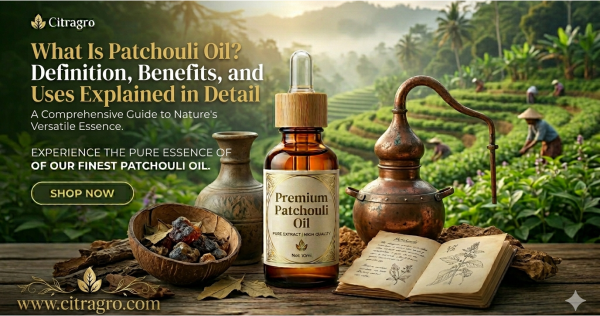
What Is Patchouli Oil? Definition, Benefits, and Uses Explained in Detail
What Is Patchouli Oil? An Introduction to Indonesia’s Most Famous Essential Oil
Have you ever sprayed perfume in the morning and still caught its scent late in the afternoon? Or felt an instant wave of calm while inhaling a warm, woodsy aroma at a spa? Behind those experiences, there’s an unsung hero: patchouli oil.
Patchouli oil is far more than just a fragrance. For the global perfume industry, it acts as an invisible anchor – making other scents last much longer. For smallholder farmers on the slopes of Indonesia’s Barisan Mountains, patchouli oil is a generational livelihood. And for anyone exploring natural living, it’s a versatile companion that can ease stress, improve skin, and even repel mosquitoes.
This guide takes you deep into the world of patchouli oil – from its botanical origins to its million-dollar role in luxury perfumery – using clear, original language and practical insights.
1. What Exactly Is Patchouli Oil?
Let’s start from the ground up.
Patchouli oil is a concentrated essential oil steam-distilled from the dried leaves of the plant Pogostemon cablin, a bushy herb in the mint family (Lamiaceae). The plant has soft, hairy leaves and an upright stem. When you crush a fresh leaf between your fingers, it releases a distinctive earthy, slightly camphoraceous scent.
In Indonesia, patchouli is known locally as nilam or nilam wangi (fragrant nilam). But don’t confuse it with ornamental varieties – Pogostemon cablin is the high-oil-yielding type prized by distillers worldwide.
Where Does the Name “Patchouli” Come From?
The word “patchouli” is believed to derive from the Tamil words patchai (green) and ellai (leaf). Another theory traces it to the Hindi pacholi – a type of perfume. Centuries ago, traders would layer precious silk and cotton fabrics with dried patchouli leaves to repel moths and insects. Over time, the scent became so desirable that it was intentionally added to fine textiles.
Little-Known Facts About Patchouli Oil
- Patchouli oil actually improves with age – the opposite of most essential oils, which degrade over time. Properly stored patchouli becomes smoother and richer after 6–12 months.
- During the 19th century, spice traders from Sumatra tucked dried patchouli leaves between cargoes of agarwood and cloves. They knew the scent wouldn’t interfere but would instead enhance market value.
- Despite decades of research, no synthetic replica has fully matched the complexity of natural patchouli oil. High-end perfumers still rely on the real thing.
2. The Journey – From Patchouli Leaf to Golden Drop
Making patchouli oil isn’t just “boil leaves, collect oil”. It’s a craft passed down through generations. Here are the essential steps.
2.1. Planting Patchouli – It’s Not About Seeds
You cannot grow patchouli from seeds. Farmers use stem cuttings about 10–15 cm long, taken from vigorous mother plants. These cuttings are rooted in moist, well-drained soil.
Interesting fact: patchouli is picky about altitude. It thrives best at 200–600 meters above sea level with evenly distributed rainfall. At higher elevations, the oil becomes thin and lacks character. In hot lowlands, the plant flowers too quickly, reducing oil quality and yield.
2.2. Harvesting at the Right Moment
Patchouli leaves cannot be harvested just any time. The best window is mid-morning (around 8–10 AM) after morning dew has evaporated. Leaves picked too wet will invite mold during drying. Leaves picked in the late afternoon tend to be wilted and produce less oil.
An experienced farmer from Solok, West Sumatra once said: “Patchouli is like a toddler – fussy if woken up at the wrong time, but if you catch it when it’s fresh, it gives you the most oil.”
2.3. Drying – The Often-Underestimated Step
Many assume fresher is better for essential oil distillation. But for patchouli, drying is essential. Why?
- Too much water makes the distillation long and fuel-inefficient.
- Dried leaves have more brittle cell walls, so the oil is released more easily when steam hits them.
- During drying, mild fermentation occurs, which actually enriches aromatic compounds.
However, over-drying until the leaves crumble like crackers is destructive. Farmers traditionally dry patchouli on bamboo racks under a roof – good air circulation, no direct sunlight – for 2 to 4 days.
2.4. Steam Distillation – The Heart of the Process
In rural Aceh and North Sumatra, you’ll see large modified steel drums serving as distillation units. The principle is simple:
- The drum is filled partway with water.
- Dried patchouli leaves are loaded into a perforated basket above the water level.
- A fire is lit below; water boils, and steam rises through the leaf layer.
- The steam (now carrying volatile oil molecules) passes through a cooling pipe – usually immersed in cold water.
- The condensed liquid – a mixture of water and oil – drips into a collection vessel.
- Because patchouli oil is lighter than water, it floats to the top and can be skimmed off.
This process takes 6–10 hours. From 100 kg of dried leaves, you typically get only 1–1.8 liters of pure patchouli oil. That scarcity explains its price.
2.5. Aging – Why Older Is Actually Better
Freshly distilled patchouli oil has a raw, sharp, almost grassy edge that many find unpleasant. That’s why professional distillers never sell it immediately.
Instead, they store the oil in stainless steel drums or dark glass containers in a cool, shaded place for 3 to 6 months – sometimes even longer. During this aging process:
- Slow esterification creates new aromatic compounds.
- Light, volatile components with harsh notes evaporate.
- Patchouli alcohol molecules stabilize and become more dominant.
The result: a smooth, deep, tenacious aroma that luxury perfumers crave. No top perfume brand will buy patchouli oil that hasn’t been aged for at least three months.
3. The Magic Behind the Scent – Key Chemical Components
Although patchouli oil contains dozens of compounds, one molecule stands out as the star: patchouli alcohol (PA).
Patchouli Alcohol – The Quality Indicator
Standard patchouli oil contains 30–35% patchouli alcohol. Premium oil from Aceh, Indonesia, can reach 38–42%. The higher the PA percentage:
- The stronger the fixative ability (locking in other fragrance molecules)
- The longer the oil lasts on skin (up to 12+ hours)
- The higher the market price
Supporting Compounds
Beyond PA, about 50 other compounds work synergistically:
- α-bulnesene – contributes a woody, sandalwood-like nuance
- α-cedrene – adds a subtle spicy-spruce note
- Pogostol – linked to calming effects on the nervous system
- Seychellene – enhances longevity on fabrics
What’s remarkable is that no synthetic blend has ever fully replicated this natural complexity. Major fragrance houses (Firmenich, Givaudan, IFF) have invested millions in trying – and they still rely on natural patchouli oil from Indonesia.
Also Read: Indonesia’s Premium Patchouli Oil Supplier for Export
4. 7 Health and Wellness Benefits of Patchouli Oil
Over the past two decades, the global shift toward natural wellness has boosted patchouli’s popularity. Here are its main benefits – some backed by studies, others rooted in traditional use.
4.1. Stress Relief and Better Sleep
Add 2 drops of patchouli oil to a diffuser or a tissue and inhale slowly. The effect is similar to drinking warm chamomile tea – slower heartbeat, calmer mind. Patchouli alcohol interacts with the limbic system, the brain’s emotional center.
Aromatherapists in Bali often blend patchouli with lavender for clients dealing with mild anxiety or insomnia.
4.2. Skin Support – Acne and Scar Fading
It sounds paradoxical – an oil for acne-prone skin? Yes, because patchouli oil has antiseptic (kills acne-causing bacteria) and anti-inflammatory (reduces redness and swelling) properties.
Never apply undiluted. Mix 1 drop of patchouli oil with 10 drops of jojoba or fractionated coconut oil, then dab onto affected areas.
For old scars: massage the diluted blend in gently every night. A small Thai study (2019) found that an 8-week application of patchouli plus vitamin E oil faded acne scars by up to 40%.
4.3. Sore Muscle Relief After Workouts
Patchouli oil has mild rubefacient properties – it creates a warming sensation on the skin, improving blood flow to stiff muscles. Try this DIY massage blend:
4 drops patchouli oil + 4 drops eucalyptus oil + 2 tablespoons olive oil. Massage onto calves or shoulders after a long run.
This mix is popular among trail runners in West Java.
4.4. Natural Mosquito Repellent
Since colonial times, Europeans stored patchouli-scented cloth sachets in wardrobes to repel moths. Turns out, the strong, earthy odor confuses the olfactory receptors of Aedes aegypti mosquitoes.
Make a simple room spray:
- 100 ml warm water
- 10 drops patchouli oil
- 5 drops citronella oil (optional)
Shake well in a spray bottle. Mist around room corners – avoid spraying directly on skin without dilution.
4.5. Freshening Smelly Shoes
Here’s a practical trick: athletic or work shoes can develop unpleasant odors over time. Don’t just spray perfume – that only masks the smell briefly. Instead:
Put 1 drop of patchouli oil on a cotton ball and leave it inside each shoe overnight. By morning, the musty smell is replaced by a clean, woodsy, masculine scent.
4.6. Handmade Soap Ingredient
Patchouli oil is a favorite among DIY soap makers because its scent survives the saponification process – many other essential oils fade or change. It also gives natural soap a beautiful light brown hue.
Tip: add patchouli at trace (when the soap mixture thickens to pudding consistency) for best scent retention.
4.7. Meditation and Yoga Aid
In several yoga studios in Ubud, patchouli-scented candles are used for evening meditation sessions. The “grounding” aroma helps practitioners feel more connected to their breath and body – less mental chatter, more presence.
5. The Perfume Industry – Patchouli’s True Home
It’s no exaggeration: without patchouli, modern perfumery would lose its backbone.
As a Fixative
Every perfume has three layers of scent:
- Top notes – citrus, lavender, light florals; evaporate within 15–30 minutes
- Middle notes – rose, jasmine, cinnamon; last 2–4 hours
- Base notes – patchouli, vanilla, amber, musk; linger for 6+ hours
Patchouli oil is one of the world’s finest base notes because it adsorbs and locks in top and middle note molecules. Result: your perfume still whispers on your skin after a full day’s work.
Famous Perfumes Containing Patchouli
Some iconic fragrances rely on patchouli as a structural ingredient:
- Chanel Coco Mademoiselle – patchouli provides a modern, long-lasting twist
- Thierry Mugler Angel – helped popularize patchouli in gourmand (sweet) perfumes
- Guerlain L’Homme Idéal – patchouli bridges almond and leather notes
- Dior Fahrenheit – patchouli links floral and leather accords
Even in local Indonesian perfumery, patchouli is often a selling point because of its availability and quality.
Why Does the Industry Prefer Indonesian Patchouli?
According to a buyer from a British perfume house who toured Aceh in 2023: “Sumatran patchouli oil has the richest, most complex profile. The earthy, balsamic character is perfect – not too sharp, and the tenacity is outstanding. Patchouli from other countries (China, India) tends to be thinner and fades faster.”
That reputation allows Indonesian patchouli to command a 20–30% premium over Vietnamese or Indian oils.
Also Read: Secrets of Indonesian Patchouli Oil: World-Class Quality
6. Business Opportunities – From Village to Global Market
You don’t need a huge plantation to profit from patchouli. There are several entry points.
Level 1: Contract Farmer
Partner with a distillery. They provide seedlings and training; you plant on your own land. The distillery buys your dried leaves at an agreed price. Risks and rewards shared. Net profit per hectare can reach $4,000–7,000 per year depending on market prices.
Level 2: Small-Scale Distiller
Collect leaves from several farmers in your village and operate your own still. Initial investment for a small copper or stainless steel still is roughly $1,500–3,000. Profits are much larger because crude patchouli oil sells for 5–10 times the price of dried leaves.
Level 3: Bottler & Brand Owner
Buy crude patchouli oil in bulk, then package it into small (5–15 ml) amber glass bottles with your own label. Target aromatherapy shops, yoga studios, and online marketplaces. Retail prices can reach $15–40 per 10 ml for premium branding – a substantial markup from wholesale.
Level 4: Exporter
This requires licenses, quality certification, and international networking. But the payoff is huge: exporting directly to France, Switzerland, or the US can yield 300% margins compared to local sales. Young entrepreneurs in Medan and Banda Aceh have successfully used LinkedIn and attended In-cosmetics trade shows to find buyers.
Estimated Prices (2025 – indicative)
- Dried patchouli leaves (farm gate) : $0.80 – 1.20 per kg
- Crude patchouli oil (standard, 30-33% PA) : $50 – 80 per liter
- Premium patchouli oil (>38% PA) : $120 – 160 per liter
- Retail 10 ml bottle (nice packaging) : $10 – 25
Prices fluctuate seasonally, especially at the start of the rainy season or when European demand shifts.
7. How to Spot Genuine vs. Adulterated Patchouli Oil
Because patchouli oil is relatively expensive, adulteration happens – often with mineral oil, used cooking oil, or solvents. Run these four simple tests:
1. Blotter Paper Test
Put one drop of oil on a white paper. Wait two hours. Genuine patchouli oil leaves a very faint ring and still smells distinctly earthy. Adulterated oil (mixed with fixed oils) makes the paper translucent and greasy like cooking oil.
2. Alcohol Solubility Test
Authentic patchouli oil dissolves completely in 95% alcohol (clear solution). Adulterated oil will appear cloudy, or oil droplets will remain undissolved.
3. Freezer Test
Place the oil in a home freezer (-10°C) for an hour. Pure patchouli oil stays liquid. If mixed with coconut or palm oil, it will partially solidify or turn cloudy.
4. Aging Test
Buy two small bottles. Use one now; store the other for 6 months. If after 6 months the aroma has become smoother and deeper, it’s genuine. If the scent has weakened or turned rancid, it’s either fake or low quality.
8. Myths and Facts About Patchouli Oil
Let’s clear up some common misunderstandings.
| Myth | Fact |
|---|---|
| Patchouli oil is only for older people | Many young niche-perfume lovers adore patchouli for its uniqueness and longevity |
| Patchouli oil causes headaches | Headaches usually come from over-application or low-quality oil containing solvent residues |
| Must be stored in the refrigerator | No – cold can cause some components to precipitate. Just keep in a cool, dark place |
| Darker color means better quality | Not necessarily. Dark color can result from over-distillation or dirty containers. Best color is pale gold to light brown |
| Can be taken internally for health | Strongly discouraged – patchouli oil is for external use and aromatherapy only |
9. Proper Storage to Extend Shelf Life
Patchouli oil is valuable – don’t let poor storage ruin it.
- Dark glass bottles (cobalt or amber). Avoid plastic; patchouli oil can dissolve some plastics.
- Tightly sealed – oxygen is the enemy of essential oils.
- Keep away from sunlight and heat sources.
- Stable temperature – ideally 59–77°F (15–25°C).
- Label with date of production or purchase. High-quality patchouli oil remains stable for 5–8 years when stored correctly.
Conclusion: Patchouli Oil – Indonesia’s Hidden Treasure
Patchouli oil is more than a commodity. It’s an identity, a heritage, and a sustainable economic future for thousands of farming families across the Indonesian archipelago. When you buy authentic patchouli oil – whether for a DIY project, a relaxing diffuser blend, or simply to understand what makes your favorite perfume last – you’re supporting smallholder farmers, traditional distillers, and a unique biodiversity that only this region provides.
So next time you spray on that signature scent, or sink into a spa massage, or light an aromatherapy candle – remember: there’s probably a drop of patchouli from Aceh or North Sumatra accompanying your day.
Thank you for reading this complete guide. Use it wisely, share it with others, and let the warm, earthy aroma of patchouli enrich your life naturally.
Ready to Start Your Patchouli Oil Journey?
Whether you’re a farmer looking to improve your distillation yield, an entrepreneur wanting to source high-quality patchouli oil, or an investor exploring Indonesia’s essential oil market – you don’t have to do it alone.
🌿 For Product & Sourcing Consultation (Powder & Essential Oils)
Need authentic Indonesian patchouli oil or other agricultural powders?
📞 WhatsApp: +62 852-5302-0372
🌐 Website: www.citragro.com
📧 Email: citragro@gmail.com
Get expert advice on quality, pricing, and direct sourcing from Indonesian farms.
📈 For Business & Property Investment
Looking to build a distillation unit, expand your aromatherapy brand, or invest in agricultural land?
🌐 Website: www.yonathanchen.com
📧 Email: yonathanchen27@gmail.com
Let’s discuss strategic partnerships, property opportunities, and business scaling in Indonesia’s patchouli industry.
Take the first step today. Contact us for a no-obligation consultation – and turn the golden drops of patchouli into your next success story.