
Secrets of Indonesian Patchouli Oil: World-Class Quality
1. Understanding Patchouli Oil: What It Is and Why It Matters
1.1 Definition of Patchouli Oil
Patchouli oil is an essential oil obtained by distilling the dried leaves, stems, and branches of the patchouli plant (Pogostemon cablin). This plant belongs to the mint family (Lamiaceae). The oil is characterized by a strong earthy scent (like wet soil), slightly woody, with a sweet undertone and remarkable longevity on skin and fabric.
In the global industry, it is universally known as patchouli oil. The name derives from the Tamil words patchai (green) and ellai (leaf), referring to the plant’s dark green leaves.
1.2 Historical Roots of Patchouli in Indonesia
Patchouli is not native to Indonesia. Experts believe it originated in South Asia, specifically India and Sri Lanka. However, during the Dutch colonial era, the plant was introduced to the archipelago.
Why did patchouli thrive so quickly? Because Indonesia’s tropical climate—year-round sunshine, high rainfall, and fertile volcanic soil—is ideal for its growth. Over time, local farmers developed superior varieties. Today, Indonesia supplies approximately 80–90 percent of the world’s patchouli oil, far surpassing other producers like India, the Philippines, and Malaysia.
1.3 Key Chemical Component: Patchouli Alcohol (PA)
If you hear the term patchouli alcohol (PA) , it is the most important compound in patchouli oil. PA is responsible for patchouli’s distinctive aroma and its primary function as a fragrance fixative.
- International quality standard (ISO 3757) : Minimum 30% PA content.
- Indonesian patchouli oil: Average 33–38%, with Aceh patchouli reaching 38–40%.
- Indian patchouli oil: Typically only 28–32%.
Even a few percentage points make a huge difference in price and competitiveness. Global buyers willingly pay more for high-PA oil because it is more efficient in perfume formulations.
2. Why Indonesian Patchouli Oil Leads the World
2.1 Highest Patchouli Alcohol Content Globally
As mentioned, Indonesian patchouli oil has the highest PA content in the world. This is not an empty claim. Various independent laboratory tests and international buyer recognition place Indonesian patchouli at the top.
Why is Indonesian PA higher? The answer lies in genetics and environment. Varieties grown in Aceh and North Sumatra have adapted over generations, optimizing PA biosynthesis. Additionally, volcanic soil rich in minerals provides complete nutrition for the plant to produce high-quality essential oil.
2.2 The Role of Tropical Climate and Volcanic Soil
Indonesia lies on the equator. Throughout the year, patchouli plants receive:
- Sunlight: 10–12 hours per day.
- Ideal rainfall: 2,500–3,000 mm per year.
- Average temperature: 25–30°C.
- Humidity: 60–80%.
Volcanic soil in regions such as Aceh, North Sumatra, Sulawesi, and Java contains high levels of phosphorus, potassium, and magnesium. These minerals stimulate the formation of aromatic compounds. This is something that subtropical or dry tropical countries cannot imitate.
2.3 Main Producing Regions and Their Unique Characteristics
Indonesia has several patchouli production centers, each with distinct characteristics.
Aceh
Aceh is the icon of Indonesian patchouli. Aceh patchouli is known for the highest oil yield (2.5–5%) and PA content of 38–40%. Its aroma is sharp, earthy, and extremely long-lasting. Pidie Jaya, Bener Meriah, and Aceh Besar are the main locations.
North Sumatra
Areas such as South Tapanuli and Mandailing Natal produce patchouli with stable PA levels of 33–36%. The aroma tends to be woodier compared to Aceh. This region is also a hub for medium-scale processing.
Central Sulawesi
This province is the second-largest patchouli barn after Aceh. Land area for patchouli in Central Sulawesi reaches thousands of hectares. The oil character is slightly lighter but still export-quality.
East Java
Although smaller in scale, East Java is developing patchouli on smallholder plantation lands. East Java patchouli oil tends to have a sweeter aroma.
3. From Leaf to Oil: The Complete Production Process
Understanding the journey from fresh leaves to export-grade oil requires following these essential steps.
3.1 Good Agricultural Practices for Patchouli
Selecting Superior Seeds
Farmers use stem cuttings because the plant rarely flowers. Superior cuttings are taken from healthy mother plants aged 6–8 months, with strong stems and dense leaves. Recommended varieties are Aceh patchouli or Tapaktuan patchouli.
Land Preparation and Planting
Soil must be loose, pH 6–7, and not waterlogged. Common planting distances are 60 cm x 80 cm or 80 cm x 80 cm. Planting is done at the start of the rainy season to avoid drought stress.
Crop Maintenance
Weeding is done every 2–3 months. Fertilization uses manure or NPK at appropriate doses. Major pests include leaf caterpillars and mealybugs; control can be achieved with botanical insecticides.
3.2 Harvesting and Drying
The first harvest can be done at 6–8 months of age. Plants are cut 15–20 cm above ground level. The remaining stumps will regrow new shoots, allowing 3–4 harvests per year from the same field.
Drying is a critical step. Fresh leaves and stems have 75–80% moisture content. If distilled immediately, the water vapor would lower yield and quality. Drying is done by shade-drying (air drying under cover) for 5–9 days until moisture drops to around 15%. Never sun-dry, as direct sunlight damages aromatic compounds.
3.3 Distillation Techniques
Steam Distillation
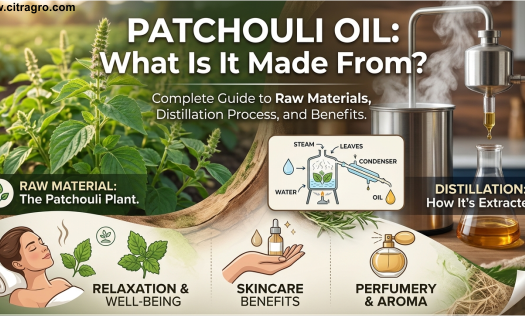
The most common method in Indonesia is steam distillation. Here is the process:
- Dried, chopped patchouli is loaded into a distillation vessel (usually stainless steel or copper).
- Water is heated in a separate boiler to produce steam (100–120°C).
- Steam is passed through the vessel containing patchouli. The steam breaks cell walls and carries oil molecules.
- The steam+oil mixture rises into a condenser (cooler) and turns back into liquid.
- The liquid is collected in a separator. Patchouli oil (lighter) floats on top, while patchouli water (hydrosol) settles below.
- The oil is separated, filtered, and packaged.
Distillation lasts 6–8 hours. Yield is about 2.5–3% of the dry material weight. That means to produce 1 kg of patchouli oil, approximately 35–40 kg of dried leaves are needed.
Modern Technology – Molecular Distillation
A breakthrough innovation from the Atsiri Research Center (ARC) at Syiah Kuala University is molecular distillation. This technology can purify patchouli oil to 99.8% PA content in crystal form. It opens up high-value derivative product opportunities.
3.4 Quality Standards Before Export
Export-bound patchouli oil must pass laboratory testing with the following parameters:
| Parameter | SNI / ISO Standard |
|---|---|
| Patchouli alcohol (PA) | Min. 30% |
| Specific gravity (25°C) | 0.943–0.983 |
| Refractive index (20°C) | 1.506–1.516 |
| Optical rotation | -47° to -66° |
| Ester value | Max. 10 |
| Appearance | Yellowish brown to dark brown |
| Purity | Free from chemical contaminants |
Additionally, certificates such as Halal (for Middle Eastern markets) and ISO 9001 are often required.
4. Benefits of Patchouli Oil for Various Industries
Patchouli oil is far more than a fragrance. Here are the benefits that keep global buyers coming back.
4.1 As a Fixative in Perfumery
The most important and most valuable function of patchouli oil is as a fixative – an aroma binder. In perfume formulation, there are three layers: top notes (initial scent, fast evaporating), middle notes (heart), and base notes (foundation scent, most long-lasting). Patchouli oil is a base note.
How does it work? Patchouli alcohol molecules have a large molecular weight and low vapor pressure, so they do not evaporate easily. They form bonds with lighter fragrance molecules, slowing their evaporation. The result: perfume can last 12–24 hours on the skin.
Almost all world-class perfumes – from Chanel to Dior – contain patchouli oil in their secret formulas.
4.2 Skin Care Benefits
Moisturizing and Balancing
Patchouli oil helps maintain skin moisture without clogging pores. It suits all skin types, including oily skin.
Anti-Acne and Antiseptic
The natural antibacterial compounds in patchouli effectively fight Propionibacterium acnes, the bacteria that cause acne. A few diluted drops can be used as a spot treatment.
Anti-Aging
Patchouli oil stimulates collagen and elastin production, two proteins that keep skin firm. Regular use can reduce fine lines, wrinkles, and dark spots.
4.3 Health and Wellness Benefits
Aromatherapy for Relaxation
The earthy scent of patchouli provides a grounding effect. In a diffuser, patchouli helps reduce stress, anxiety, and insomnia. Many aromatherapists recommend patchouli for evening relaxation sessions.
Natural Anti-Inflammatory
Compounds in patchouli have anti-inflammatory properties. This is useful for relieving muscle pain, joint pain, or headaches when applied in a blended massage oil.
Anti-Fungal for Scalp Health
Dandruff is often caused by Malassezia fungus. Patchouli oil, with its anti-fungal activity, can combat dandruff and maintain healthy hair.
4.4 Other Lesser-Known Benefits
- Natural insect repellent: Mosquitoes and ants dislike patchouli’s strong scent. Mix patchouli with coconut oil for a natural anti-mosquito lotion.
- Natural deodorant: Antibacterial properties suppress odor-causing bacteria.
- Natural room freshener: A few drops on a tissue or in a diffuser make a room smell warm and calming.
Also Read: : Indonesia’s Premium Patchouli Oil Supplier for Export
5. Business and Export Opportunities for Indonesian Patchouli Oil
5.1 Latest Export Data (2024–2025)
Patchouli oil is the star of Indonesia’s essential oil exports. According to the Ministry of Industry:
- Total Indonesian essential oil exports (2024) : USD 259.54 million (approx. IDR 4.2 trillion).
- Patchouli oil contribution: 54% or USD 141.32 million (IDR 2.2 trillion).
- Patchouli oil export volume: 1,200–1,500 tons per year.
5.2 Main Export Destination Countries
Here are the primary markets for Indonesian patchouli oil:
| Region | Destination Countries |
|---|---|
| Europe | France, United Kingdom, Switzerland, Germany |
| Americas | United States |
| Asia | India, Japan, Singapore |
| Middle East | United Arab Emirates, Saudi Arabia |
France is the largest buyer because it is the world’s perfume capital. In April 2025, Aceh successfully exported 1 ton of patchouli oil directly to Nat’ Green perfume company in France – a milestone for direct export from the production region.
5.3 Global Market Projections
According to market research reports, the global patchouli oil market value in 2025 reached approximately USD 1.73 billion and is projected to grow to USD 2.94 billion by 2032, with a compound annual growth rate (CAGR) of 6.5%.
Growth drivers:
- Back-to-nature trend: Consumers shifting to natural over synthetic products.
- Expanding perfume industry in Asia and the Middle East.
- Innovation in derivative products such as skincare, soaps, and aromatherapy candles.
5.4 Challenges Faced by Exporters
Despite bright prospects, there are several hurdles:
- Extreme price fluctuations
At the end of 2024, prices reached IDR 2.4 million/kg, but by mid-2025, they plunged to IDR 600–700 thousand/kg. This is due to new European regulations accepting only ≥30% PA oil. - Inconsistent quality
Many small-scale distillers lack good operational standards. As a result, PA levels can drop below standard, suppressing selling prices. - Lack of downstream processing
Most exports are still in raw oil form. Value addition is captured by importing countries that process it into perfumes or cosmetics. - Competition from synthetic oil
Some chemical companies are developing synthetic patchouli alcohol, though quality still cannot match natural patchouli.
5.5 Government Support for Businesses
The Indonesian government is not idle. Several ongoing programs include:
- Essential Oil SME Loans: State-owned banks (BRI, BNI, Mandiri, BSI) provide small business credit with low interest. Total allocated funds reach IDR 200 trillion until 2026.
- Training and mentoring from the Ministry of Cooperatives and SMEs and local plantation services.
- Facilitation of international trade fairs such as in-cosmetics Global in Europe.
6. Practical Guide to Starting a Patchouli Oil Business
If you are interested in entering this business, follow these step‑by‑step guidelines.
6.1 Choose Your Business Model
There are four main paths you can take:
- Patchouli Farmer → Grow and care for plants, sell dried leaves to distillers. Initial capital per hectare: IDR 20–30 million.
- Distiller → Buy dried leaves, distill into oil, sell to traders or exporters. Distillation equipment investment starts from IDR 50 million (small scale).
- Exporter → Buy oil from several distillers, test quality, then export. Requires knowledge of export documents and international connections.
- Derivative Product Brand Owner → Make perfumes, soaps, candles, or skincare based on patchouli. This model has the highest profit margin.
For beginners, start as a farmer or home‑scale distiller while learning the market.
6.2 Prepare Legal Documents and Certifications
Before selling to export markets, ensure you have:
- Certificate of Analysis (CoA) from an accredited lab (e.g., BPOM, ITS, UI).
- SNI 06-2385-2006 for patchouli oil.
- Halal Certificate (mandatory for Middle Eastern and Muslim‑majority markets).
- ISO 9001 if possible (increases buyer confidence).
- Certificate of Origin (SKA) to obtain preferential tariffs.
6.3 Effective Digital Marketing Strategy
You don’t need a fancy office to sell patchouli oil overseas. Use digital channels:
- Professional website → Optimize for keywords: “Indonesian Patchouli Oil Supplier”, “High PA Patchouli Oil”, “Bulk Patchouli Oil Export”. Create content like this article to attract organic buyers.
- B2B marketplaces → List on Alibaba, Indotrading, TradeIndia. Complete your profile with high‑quality product photos, distillation process videos, and CoA.
- LinkedIn → Search for purchasing managers at European and American fragrance companies. Send professional messages highlighting your product’s PA advantage.
- Trade fairs → Attend in-cosmetics Global (Barcelona/Paris), Fi Europe (Frankfurt), or Natural Products Expo (USA).
6.4 Negotiation Tips with International Buyers
- Show lab data (CoA) from the start. Don’t hesitate to state your PA content.
- Offer samples (usually 50–100 ml) with shipping costs borne by the buyer.
- Don’t just sell price, tell a story: patchouli from Indonesian farmers with high quality standards.
- Use appropriate incoterms such as FOB or CIF based on your capability.
7. Innovation and the Future of Indonesian Patchouli Oil
7.1 Downstream Processing: The Key to Adding Economic Value
For too long, Indonesia has been only a raw material exporter. As a result, most value addition is captured by perfume factories in France and cosmetics companies in the US. Downstream processing means transforming raw patchouli oil into finished products domestically.
Example of successful downstream processing:
The Atsiri Research Center (ARC) at Syiah Kuala University developed molecular distillation, which purifies patchouli oil to 99.8% PA (in crystal form). This technology has produced more than 30 derivative products, patented and commercialized, and won the Indonesia Innovator Award 2025.
7.2 Derivative Products You Can Develop
Don’t just sell crude oil. Create your own branded products:
- Niche local perfumes → Blend patchouli with other essential oils like clove, cinnamon, or citrus. Sell through online shops or souvenir boutiques.
- Natural soaps and anti‑dandruff shampoos → Use patchouli as an active anti‑fungal ingredient.
- Aromatherapy candles → Mix patchouli with beeswax or soy wax. Beautiful packaging with the story of Aceh patchouli will attract global buyers.
- Anti‑aging skincare → Night creams or serums featuring patchouli as a key ingredient. Claim collagen‑boosting benefits.
7.3 The Role of Young Entrepreneurs and Technology
The future of Indonesian patchouli lies in tech‑savvy young people. Suggested actions:
- Digitize the supply chain: Use apps to record stock, prices, and oil quality.
- Educate farmers via YouTube about proper distillation techniques.
- International marketing through TikTok and Instagram for derivative products.
With innovation and collaboration, Indonesia can move from being a mere raw material supplier to a high‑value finished product manufacturer recognized worldwide.
8. Conclusion: Indonesian Patchouli Oil, a Treasure to Protect
Indonesian patchouli oil is living proof that the archipelago’s biodiversity can compete on the global stage. With top‑tier quality (38–40% PA), a market share of 80–90%, and continuously growing economic value, patchouli is a strategic commodity that cannot be ignored.
However, this glory demands collective effort:
- Farmers must adopt superior seeds and proper drying techniques.
- Distillers need to modernize equipment and maintain consistent quality.
- Exporters should build international networks and secure certifications.
- Government must continue providing funding support and trade fair facilitation.
- Young people can develop derivative products and digital marketing.
If you want to start a patchouli oil business, remember: quality, consistency, and connections are the three pillars of success. The world currently hungers for authentic natural ingredients. And Indonesia, with all its advantages, is ready to provide the answer.
Let’s make Indonesian patchouli oil shine brighter on the world stage!
FAQ (Frequently Asked Questions)
1. What is the minimum patchouli alcohol (PA) content for export?
Minimum 30% according to ISO 3757. However, premium buyers often look for above 35%. Aceh patchouli oil can reach 38–40%.
2. Why does patchouli oil price fluctuate so drastically?
Fluctuations occur due to changes in global market regulations (e.g., European countries accepting only ≥30% PA), weather conditions affecting production, and demand dynamics from the perfume industry.
3. Is patchouli oil safe to apply directly to skin?
No. Patchouli oil is a concentrated essential oil. It must be diluted with a carrier oil (coconut, jojoba, olive) at 1–2% concentration. Direct application can cause irritation.
4. How can I tell authentic patchouli oil from adulterated oil?
Authentic patchouli oil: thick liquid, yellowish‑brown to dark brown color, strong earthy aroma that lasts long on a test strip. For quality certainty, perform gas chromatography (GC) lab testing.
5. What certifications are required for patchouli oil export?
Essential documents: Certificate of Analysis (CoA), SNI, Halal Certificate, ISO 9001 (recommended), Certificate of Origin (SKA), and customs documents.
6. Can I start a patchouli oil business with small capital?
Yes. You can begin as a farmer on 0.5 hectare or as a small‑scale distiller (100–200 liter kettle). Start with the local market first, then gradually move up to export.
7. Are there derivative product opportunities beyond crude oil?
Many. Local perfumes, natural soaps, aromatherapy candles, anti‑dandruff shampoos, anti‑aging creams, and room fresheners are examples of products with much higher profit margins.
Ready to Start Your Patchouli Oil Business or Expand Your Export?
Let’s Discuss Your Needs – Contact Us Today!
You have learned everything about Indonesian patchouli oil: its superior quality, production process, global market potential, and step‑by‑step business strategies. Now, it’s time to take action.
Whether you are a farmer, distiller, exporter, or brand owner, we are here to help you succeed. Get expert consultation tailored to your goals.
📞 Quick Contact – WhatsApp
+62 852 5302 0372
Click to chat – we respond within hours
Need Consultation on Indonesian Powder Products?
If you are looking for high‑quality Indonesian powder products (spices, herbal powders, or other agricultural commodities), our team at Citragro is ready to assist you.
- Website: www.citragro.com
- Email: citragro@gmail.com
We provide sourcing, quality control, and export guidance for various Indonesian powder products trusted by buyers worldwide.
Business & Property Consultation
For entrepreneurs who want to expand beyond patchouli oil – into general business strategy, investment, or property consultation – Yonathan Chen offers professional advisory services.
- Website: www.yonathanchen.com
- Email: yonathanchen27@gmail.com
Get personalized advice on growing your business, managing assets, and making smart investments in Indonesia.
Take the Next Step Now
Don’t let this knowledge go to waste. Whether you want to:
- ✅ Source premium patchouli oil for export
- ✅ Consult on Indonesian powder products
- ✅ Get business or property advice
Reach out today. Your journey into the world of Indonesian natural commodities starts with a single message.
WhatsApp: +62 852 5302 0372
We look forward to partnering with you!