
What Is Patchouli Oil Made From? Complete Guide to Raw Materials, Distillation Process, and Benefits
The “Liquid Gold” of the Archipelago
Indonesia is the world’s largest producer of essential oils. Among the hundreds of essential oil varieties, Patchouli Oil holds a special place as the irreplaceable “fixative” in the global perfume industry. It is often called “Green Gold” because of its high economic value.
But despite its fame, many people still don’t understand the most basic question: What is patchouli oil made from?
Is it from the roots? Stems? Flowers? Or is it a chemical concoction?
This pillar article will answer that question thoroughly. You’ll learn about the botanical identity, the traditional and modern distillation processes, the chemical secrets behind its long-lasting scent, and why Indonesia dominates this market. By the end, you’ll see patchouli oil not just as a fragrance ingredient, but as a strategic commodity.
Chapter 1: The Short Answer – What Is Patchouli Oil Made From?
Let’s set the record straight immediately.
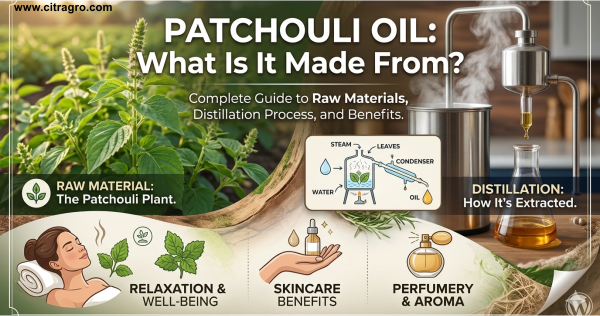
Patchouli oil is made from the dried leaves and tender stem tips of the patchouli plant (Pogostemon cablin Benth), extracted through steam distillation.
Unlike olive oil (pressed from fruit) or tea tree oil (distilled from fresh leaves), patchouli oil has a unique requirement: the raw material must be withered and dried before distillation. This drying process creates the deep, earthy, long-lasting aroma that patchouli is famous for.
The Patchouli Plant: A Hairy Leaf Full of Oil Glands
Patchouli belongs to the Lamiaceae family – the same family as mint, basil, and lavender. Its key characteristics are:
- Leaves: Oval-shaped with serrated edges, covered in fine hairs (trichomes). These hairs contain the essential oil glands.
- Stem: Soft-wooded, greenish to brownish.
- Plant Height: Can reach up to 1 meter (3 feet) under optimal conditions.
So when someone asks “What is patchouli oil made from?”, the most accurate answer is: the oil glands inside the dried leaves of Pogostemon cablin. The highest oil concentration is found in mature top leaves – not in young leaves, stems, or roots.
Chapter 2: Varieties of Patchouli in Indonesia – Which One Makes the Best Oil?
Not all patchouli plants are equal. Indonesia, which supplies 90% of the world’s patchouli, has three main varieties:
| Patchouli Type | Scientific Name | Key Characteristics | Primary Use |
|---|---|---|---|
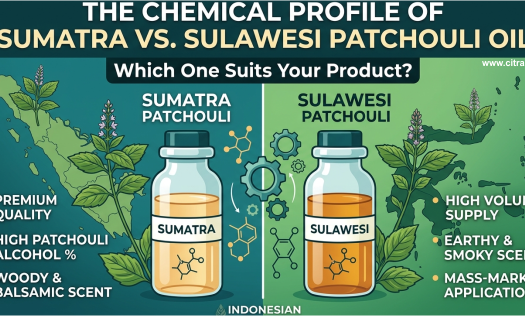
| Aceh / Sidikalang | Pogostemon cablin Benth | Patchouli Alcohol (PA) >30%, strong aroma, excellent fixative | Luxury perfumes, high-end cosmetics |
| Java Patchouli | Pogostemon heyneanus | Low PA (<20%), lighter scent | Cheap perfumes, aromatherapy blends |
| Soap Patchouli | Pogostemon hortensis | Very low oil yield, weak aroma | Traditional rituals, soap additives |
Key takeaway: When professionals ask “What is patchouli oil made from?”, they expect Pogostemon cablin (Aceh variety) as the answer – because that’s the only variety with high enough Patchouli Alcohol content for international standards.
Chapter 3: The Long Journey – From Farm to Essential Oil
Knowing that patchouli oil is made from leaves is only the first step. The transformation from a green leaf to a thick golden liquid is an art form. Here’s the complete step-by-step process.
3.1. Land Preparation and Planting
Patchouli loves loose, humus-rich soil with pH 5.5–6.5. Ideal rainfall is 2,500–3,000 mm/year with temperatures of 24–28°C (75–82°F). Farmers typically plant stem cuttings 10–15 cm long. After 6–8 months, the plants are ready for harvest.
3.2. Harvesting at the Right Time
Harvest timing is critical for quality. Leaves are harvested when the plant is 6–8 months old, just before the flowering stage. Why? Because once the plant starts flowering, it redirects energy and secondary metabolites (including essential oils) to the flowers. Oil content in leaves drops significantly.
3.3. Wilting and Drying (The Magic Step)
This is the most misunderstood step. Fresh patchouli leaves should NOT be distilled immediately. Why?
- Breaking cell walls: Drying makes the oil gland cell walls brittle and cracked, so oil is released more easily during distillation.
- Enzymatic reactions: Controlled drying allows enzymatic reactions that form the precursor compounds of patchouli’s signature scent.
Freshly harvested leaves are spread on bamboo racks and air-dried for 2–3 days until moisture content drops from ~75% to 15–18%. Do not overdry – if leaves become crispy like potato chips, the oil may evaporate along with the water.
3.4. Distillation Methods
Here’s where the question “What is patchouli oil made from?” meets the how. Dried leaves are loaded into a distillation kettle. There are three common methods:
| Method | Description | Pros & Cons |
|---|---|---|
| Water Distillation | Leaves submerged directly in boiling water | Cheap, but high risk of burning the oil |
| Water & Steam Distillation | Leaves on a perforated screen above boiling water | Most popular for small farmers – balanced quality |
| High-Pressure Steam Distillation | Superheated steam from a separate boiler | Best quality, highest yield, industrial standard |
After steam passes through the leaf pile, it carries essential oil molecules. The steam is then condensed back into liquid. The resulting liquid separates into two layers: the top layer is pure patchouli oil, and the bottom layer is hydrosol (which also has commercial value).
Chapter 4: Chemical Composition – Why Does Patchouli Smell So Unique?
Once you know that patchouli oil is made from distilled dried leaves, the next question is: What makes it so valuable? The answer lies in Patchouli Alcohol (PA).
Patchouli Alcohol (C₁₅H₂₆O)
This is the benchmark molecule for quality. Export-grade patchouli oil must contain at least 30% Patchouli Alcohol. The higher the PA content, the higher the price. PA acts as a fixative in perfumery. Light fragrance notes (like citrus or jasmine) evaporate within hours. PA slows down that evaporation, allowing a perfume to last 12–24 hours on skin.
Other Key Compounds
- Pogostone: Provides antifungal and antibacterial properties.
- Bulnesene & Guaiene: Contribute to the woody, earthy character.
- Norpatchoulenol: Enhances the long-lasting effect.
The combination of dozens of compounds makes synthetic imitation of patchouli oil extremely difficult.
Chapter 5: Benefits of Patchouli Oil Across Industries
Now that we’ve fully answered “What is patchouli oil made from?”, let’s see why the world needs it.
5.1. Perfume Industry (The Ultimate Fixative)
Every niche or luxury perfume contains patchouli oil. Chanel No. 5, Gucci by Gucci, Tom Ford White Patchouli – all rely on patchouli as a base note. Without patchouli, perfumes would change their scent within hours or lack depth.
5.2. Aromatherapy & Mental Health
In modern aromatherapy, patchouli oil is known for its grounding effect. It helps calm anxious minds, reduce stress, and fight insomnia. A 2021 study showed that inhaling patchouli oil can lower cortisol (stress hormone) levels by 25% within 30 minutes.
5.3. Skincare & Topical Applications
Due to its antifungal and anti-inflammatory properties, patchouli oil is increasingly used in:
- Anti-acne ointments: Reduces inflammation and kills Propionibacterium acnes.
- Anti-aging creams: Stimulates skin cell regeneration and reduces fine lines.
- Eczema & ringworm treatment: Used in traditional medicine across Asia.
5.4. Natural Insect Repellent
Research in the Journal of Medical Entomology proves that patchouli oil effectively repels Aedes aegypti mosquitoes (dengue vector) and ants. Several natural insect repellent brands now use patchouli as a key ingredient.
Chapter 6: Quality Standards & Challenges for Indonesian Patchouli
Indonesia supplies 80–90% of the world’s patchouli oil. But this market dominance comes with serious challenges.
6.1. International Standards (ISO 3757:2002)
To be export-ready, patchouli oil must meet:
- Patchouli Alcohol: Minimum 30%
- Specific Gravity (20°C): 0.950 – 0.975
- Refractive Index (20°C): 1.505 – 1.512
- Solubility in 90% Alcohol: Clear solution (1:10)
6.2. Main Challenges
- Price volatility: Prices swing wildly – from 100/kgduringdroughtto40/kg during bumper harvests.
- Seed quality: Many farmers still use low-yielding heirloom seeds with degraded PA content.
- Distillation technology: Traditional iron kettles contaminate oil with iron ions (Fe²⁺), turning it dark green-black and reducing price by 30–40% compared to stainless steel distilled oil.
- Adulteration: Mixing patchouli oil with vegetable oils or synthetic compounds is still common, damaging Indonesia’s reputation.
Chapter 7: How to Tell Genuine Patchouli Oil from Fake
As a buyer or consumer, you need to know how to identify pure patchouli oil. Here’s a simple guide:
| Parameter | Genuine Patchouli Oil | Fake/Adulterated Oil |
|---|---|---|
| Color | Light yellow to reddish-brown (depends on kettle material) | Too clear, or too dark/black |
| Aroma | Earthy, wet soil after rain, slightly sweet, not pungent | Sharp like gasoline, or overly floral |
| Viscosity | Thick, oily, slow-flowing | Watery, fast-flowing |
| Paper Test | Leaves a yellow ring on paper, scent lasts >24 hours | Stain disappears quickly, scent fades in 2-3 hours |
| Water Test | Forms a thin film on water surface, does not mix | Disperses rapidly or forms droplets |
Chapter 8: Business Potential – Can You Grow Patchouli at Home?
After reading this far, you might ask: Can I produce my own patchouli oil?
Answer: Yes, on a small to medium scale.
Basic Steps for Home-Scale Patchouli Farming
- Prepare 100–200 m² of land. Patchouli doesn’t need large acreage. On 100 m², you can plant 1,000–1,500 cuttings.
- Use certified Aceh patchouli seedlings from agricultural research stations.
- Harvest after 6-8 months. 1,000 plants can yield 200–300 kg of fresh leaves.
- Dry to 15–18% moisture (becomes 60–90 kg of dried leaves).
- Distill using a 50–100 kg capacity kettle. Yield from dried leaves is typically 2–3%. So 60 kg of dried leaves gives 1.2–1.8 liters of pure patchouli oil.
Estimated Profit (2024 market)
- Price of 30% PA patchouli oil: 50–70 per kg (export FOB), or locally Rp 600,000–900,000.
- From 100 m² land, potential revenue per harvest cycle: 70–150.
- With 3-4 harvest cycles per year, it’s a viable micro-business.
Chapter 9: Myths and Facts About Patchouli Oil
Let’s bust some common myths.
| Myth | Fact |
|---|---|
| Patchouli oil is made from the roots | ❌ False. It’s made from leaves and stem tips, not roots. |
| Darker oil means better quality | ❌ Not necessarily. Dark color often indicates metal contamination or overheating. |
| You can drink patchouli oil for medicine | ❌ Dangerous. Patchouli oil is for external or aromatherapy use only. |
| Everyone loves the smell of patchouli | ❌ No. The earthy scent is polarizing – some love it, some hate it. |
| Indonesia is the only patchouli producer | ❌ Mostly true. Indonesia makes 90% of world supply; the rest comes from India, China, Brazil. |
Chapter 10: Conclusion and Call to Action
After reading this complete guide, you will never be confused again when someone asks “What is patchouli oil made from?”
Short answer: Patchouli oil is made from dried leaves of Pogostemon cablin (Aceh patchouli) through steam distillation.
Long answer: Patchouli oil is the result of a careful chain: superior seeds → proper harvesting → controlled drying → clean distillation. Its high Patchouli Alcohol content makes it the world’s most valued natural fixative for perfumes.
What Can You Do Next?
- If you are a buyer: Use the quality guide in Chapter 7 to source authentic oil. Avoid suspiciously cheap products.
- If you are a farmer or entrepreneur: Switch to high-PA seedlings and stainless steel distillation equipment. Quality is everything in the export market.
- If you are a researcher: Explore patchouli’s untapped pharmaceutical potential – many compounds are still under-studied.
Looking for a Reliable Source?
✅ If you need high-quality Indonesian patchouli oil with guaranteed PA >30%, visit: Indonesia’s Premium Patchouli Oil Supplier for Export.
We work directly with certified farmers and use modern steam distillation to ensure purity, consistency, and full traceability.
FAQ (Frequently Asked Questions)
Q1: Is patchouli oil the same as tea tree oil?
A: No. Tea tree oil is made from Melaleuca alternifolia leaves (high in terpinen-4-ol) for antimicrobial use. Patchouli oil is made from Pogostemon cablin for its fixative and earthy aroma.
Q2: How long does patchouli oil scent last on clothes?
A: When stored dry, patchouli aroma can last months to years. That’s why it’s so valuable to the perfume industry.
Q3: Can I apply patchouli oil directly to my skin?
A: Always dilute with a carrier oil (coconut, jojoba) at 1:10 ratio. Undiluted patchouli oil may cause irritation on sensitive skin.
Q4: Where can I buy authentic Aceh patchouli seedlings?
A: Contact the Indonesian Spices and Medicinal Crops Research Institute (Balittro) in Bogor, or provincial agriculture offices in Aceh and North Sumatra.
Q5: What is patchouli oil made from – can it be made from fresh leaves?
A: Technically yes, but yield and quality are very poor. Fresh leaves contain too much water, making distillation inefficient, and the resulting aroma lacks depth.
Consult on Your Natural Product Needs & Property Business Opportunities
📞 Contact Us:
For Indonesian Natural Products (Patchouli Oil, Spices, etc.):
- 📱 WhatsApp (Product Consultation – Citragro Indonesia): +6285253020372
- 🌐 Website: www.citragro.com
- 📧 Email: citragro@gmail.com
For Business & Property Consultation:
- 🌐 Website: www.yonathanchen.com
- 📧 Email: yonathanchen27@gmail.com
Our team is ready to help you start or grow your business – from high-quality natural products for export to profitable property investment opportunities.