
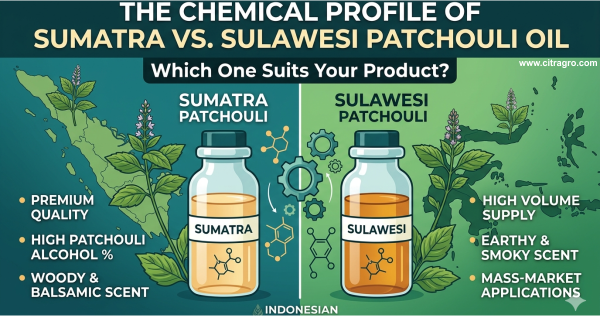
The Chemical Profile of Sumatra vs. Sulawesi Patchouli Oil: Which One Suits Your Product?
Indonesia is the undisputed king of the global patchouli market, consistently supplying over 80–90% of the world’s demand for Pogostemon cablin oil. This essential oil is far more than just a fragrance ingredient—it is nature’s most powerful fixative, a complex chemical anchor that synthetic alternatives have failed to replicate for decades. Its rich, earthy, woody, and tenacious scent makes it indispensable in fine perfumery, cosmetics, aromatherapy, and home care products.
But for modern product formulators, perfumers, and B2B procurement managers, simply buying “Indonesian Patchouli Oil” is no longer precise enough. Indonesia is an archipelago of dramatically different terroirs—volcanic highlands, coastal lowlands, and everything in between. Two regions dominate production: Sumatra (especially Aceh and West Sumatra) and Sulawesi (South, Southeast, and Central Sulawesi). Each produces oil with a distinct chemical fingerprint.
This leads to a critical strategic question for your next product launch:
The Chemical Profile of Sumatra vs. Sulawesi Patchouli Oil: Which One Suits Your Product?
In this pillar article, we deliver a laboratory-backed, side-by-side comparison of their volatile compounds, organoleptic profiles, supply chain realities, and industrial applications. By the end, you will know exactly which oil aligns with your product matrix, budget, and brand promise.
1. The Chemical Anatomy of Patchouli Oil: More Than Just Patchoulol
Before comparing regions, we must understand what makes patchouli oil valuable. Commercial quality is not defined by a single molecule but by the synergy of dozens of sesquiterpene compounds. Using Gas Chromatography-Mass Spectrometry (GC-MS), analytical chemists track five key markers:
- Patchouli Alcohol (Patchoulol): The benchmark compound. It delivers the signature earthy, sweet, balsamic base note and determines fixative strength. Higher PA content means longer-lasting fragrance anchorage.
- Alpha-Bulnesene & Alpha-Guaiene: Sesquiterpene hydrocarbons that add woody texture and subtle spicy facets.
- Seychellene: Enriches complexity, body, and viscosity.
- Alpha-Patchoulene: Influences the initial brightness and clarity of top notes.
- Acid Value: A stability indicator. Lower acid values mean better resistance to oxidation and longer shelf life.
With these parameters, let’s dissect Sumatra and Sulawesi.
2. Sumatra Patchouli Oil: Refined Purity from Volcanic Highlands
Sumatran patchouli, particularly from the highlands of Aceh (e.g., Gayo Lues) and West Sumatra, is often called the “Grand Cru” of patchouli. Grown at altitudes of 600–900 meters in fertile volcanic soil with balanced rainfall, the plant experiences mild environmental stress. Scientifically, this stress boosts secondary metabolism, resulting in higher Patchouli Alcohol concentrations.
GC-MS Chemical Profile (Typical Values)
| Parameter | Sumatra Range |
|---|---|
| Patchouli Alcohol | 31% – 38% (premium batches >38%) |
| Alpha-Bulnesene | Low to moderate |
| Acid Value | Very low (< 2.0 mg KOH/g) |
| Color | Golden yellow to light amber |
Organoleptic (Scent) Profile
- Top notes: Clean, slightly sweet, fresh-green nuance.
- Middle & base notes: Deeply woody, smooth balsamic, velvety musk. No harsh smoke or muddy earth.
- Texture: Optimally balanced viscosity, not too thick.
Why Choose Sumatra?
Sumatra patchouli is the luxury choice. Its smooth, refined profile makes it ideal for fine fragrances, high-end skincare, and any application where off-notes (smoke, damp soil) would ruin delicate floral or citrus compositions. Because of its low acid value, it also offers superior oxidative stability—perfect for products with a long shelf life.
Pro tip: For hypoallergenic or “clean beauty” claims, Sumatra’s naturally low free-fatty-acid profile reduces skin sensitization risk.
3. Sulawesi Patchouli Oil: The Volume Titan with Bold Intensity
Over the past two decades, Sulawesi has become the backbone of global patchouli supply. Vast, fertile lowlands and organized farming networks allow massive, cost-effective production. However, the coastal and lowland topography (often below 300 meters) and rapid agricultural expansion create a different chemical fingerprint.
GC-MS Chemical Profile (Typical Values)
| Parameter | Sulawesi Range |
|---|---|
| Patchouli Alcohol | 29% – 32% (meets ISO 3757 but lower than Sumatra) |
| Alpha-Bulnesene & Guaiene | High |
| Acid Value | Moderate to slightly elevated |
| Color | Dark amber to deep brown |
Organoleptic (Scent) Profile
- Top notes: Sharp, piercing, intensely camphoraceous.
- Middle & base notes: Heavy damp earth, smoky campfire, dense leafy greens, rugged and masculine.
- Texture: Heavier, more viscous body.
Perfumers often call this the “Classic Dark Patchouli” —unapologetically raw, wild, and highly diffusive.
Why Choose Sulawesi?
Sulawesi patchouli is the workhorse for mass-market products. Its sharp, smoky character easily cuts through aggressive surfactant bases in laundry detergents, bar soaps, and industrial cleaners. Moreover, its abundant supply and competitive pricing make it the go-to for FMCG corporations needing hundreds of tons per year under fixed-price contracts.
4. Head-to-Head Comparison Matrix
For quick reference by your QC and R&D teams:
| Evaluation Parameter | Sumatra (Aceh/West) | Sulawesi (South/Southeast) |
|---|---|---|
| Patchouli Alcohol | 31–38% (Superior) | 29–32% (Standard) |
| Alpha-Bulnesene | Low to Moderate | High |
| Primary Aroma | Woody, Balsamic, Sweet, Refined | Earthy, Smoky, Sharp, Bold |
| Physical Color | Warm Yellow to Light Amber | Dark Amber to Deep Brown |
| Fixative Longevity | Superior (max retention) | Very Strong (intense base presence) |
| Acid Value (Stability) | Low (Excellent) | Moderate (Handle carefully) |
| Supply Availability | Limited / Boutique / Exclusive | Massive / Global backbone |
| B2B Pricing | Premium / Higher Tier | Highly Competitive |
5. Industrial Application Guide: Which One Fits Your Product?
A. Fine Fragrance & High-End Perfumery
Winner: Sumatra Patchouli Oil
Luxury perfumery (EDP, extrait) demands seamless transition from top to dry-down. Harsh smoky or muddy notes can destroy delicate florals like jasmine or rose. Sumatra’s high patchoulol content acts as an elite fixative, anchoring volatile molecules (bergamot, neroli, iris) to the skin for 8+ hours without altering their character. Use it in Chypre, Oriental, or premium Woody fragrances.
B. Mass-Market Soaps, Detergents & Home Care
Winner: Sulawesi Patchouli Oil
Laundry detergents, fabric softeners, and dish soaps require oils that punch through chemical bases and survive high pH. Sulawesi’s sharp, pungent, smoky top notes are an asset here—they overpower synthetic odors and provide lasting freshness. Backed by year-round volume stability and low cost, Sulawesi is the operational backbone for FMCG giants.
C. Natural Skincare & Anti-Aging Formulations
Winner: Sumatra Patchouli Oil (Iron-Free or Molecular Distilled)
Facial serums, barrier repair creams, and body lotions demand absolute purity. The low acid value of Sumatran oil minimizes free fatty acid degradation, reducing irritation risk. Its naturally smooth aroma means no harsh masking agents are needed. Always choose Iron-Free grade to prevent discoloration of white emulsions.
D. Aromatherapy & Wellness Spa Products
Winner: Pure Sulawesi or Strategic Blends
For soy wax candles, grounding massage oils, or meditation mists, the intensely damp, root-like, earthy presence of Sulawesi patchouli delivers an immediate “forest bathing” experience. It triggers the limbic system for deep relaxation. However, if your spa line targets soft, meditative tranquility, blend 70% Sulawesi with 30% Sumatra to balance smoky notes with sweetness.
6. Processing Evolutions: Bridging the Regional Gap
What if you love Sumatra’s elegance but need Sulawesi’s volume and price? Modern downstream processing offers a solution via fractional distillation.
Today’s advanced distilleries produce three commercial grades:
- Raw / Dark Patchouli Oil
Directly distilled, often using traditional iron stills. Contains micro-iron particles that darken the oil. Highly sought after for heavy industrial masking or leather-forward masculine perfumes. Sulawesi dominates this grade. - Light / Iron-Free Patchouli Oil
Redistilled in stainless steel reactors to strip heavy metals (iron < 1 ppm). The result is a pale-yellow oil that will not discolor white cosmetics or translucent soaps. Both regions can produce this, but Sulawesi light grade offers cost advantage. - Molecular Distilled (MD) Patchouli Oil
Processed under high vacuum and low temperature to discard harsh, smoky top notes and free acids while concentrating patchoulol to 32–35% or higher.
Formulator’s Goldmine:
Source Molecular Distilled Sulawesi Patchouli Oil.
This strategy gives you a refined, clean profile (mimicking Sumatra’s purity), combined with Sulawesi’s abundant supply and competitive pricing. You win on both quality and cost.
7. Sustainability, Traceability & Supply Chain Dynamics
Modern procurement extends beyond GC-MS data. ESG (Environmental, Social, Governance) compliance is now a boardroom priority.
The Sumatra Landscape
In Sumatra, patchouli is grown by smallholder cooperatives on nutrient-dense volcanic soil. Land constraints require careful rotation to prevent encroachment into conservation zones like the Leuser Ecosystem. Supply chains are fragmented, boutique, and often carry Fair Trade or organic certifications. This justifies a premium price but limits scalability.
The Sulawesi Landscape
Sulawesi benefits from vast agricultural land managed by organized farming networks. Large-scale sustainability programs train farmers in eco-friendly steam distillation (using biomass like coconut shells) and strict crop rotation. For multinational corporations needing hundreds of tons annually under fixed contracts, Sulawesi offers lower operational risk and guaranteed security of supply.
Internal Resource: Learn more about responsible sourcing from Indonesia’s Premium Patchouli Oil Supplier for Export , where traceability from farm to port is guaranteed.
8. Step-by-Step Selection Framework for Procurement Teams
Use this tactical decision tree in your next product development meeting:
Start: Evaluate Your Product Needs
Step 1 – What is your projected annual volume?
- Mass-scale / continuous FMCG (hundreds of tons) → Primary target: SULAWESI
- Limited edition / niche premium (small volumes) → Go to Step 2
Step 2 – What is the primary product category?
- Fine fragrance (EDP) or high-end skincare → Primary target: SUMATRA
- Soaps, home care, candles, industrial cleaners → Primary target: SULAWESI
Step 3 – Is your COGS (Cost of Goods Sold) highly restrictive?
- Yes, efficiency is paramount → Select: SULAWESI (Dark or Light grade)
- No, brand storytelling rules → Select: SUMATRA (Aceh origin, molecular distilled)
Bonus Step – Do you need a clear, pale oil for white cosmetics?
- Yes → Select: Iron-Free version (available from both regions, but Sulawesi MD Iron-Free offers best value)
9. Real-World Case Study: Formulating an Oud & Leather Attar
A client from the Middle East wanted to create an attar (concentrated perfume oil) with heavy synthetic oud and leather accords. They needed patchouli that could withstand the desert heat and not get lost.
- Initial trial: They used Sumatra patchouli. The result was too smooth and refined; the elegant woody notes were completely swallowed by the aggressive synthetic oud.
- Solution: They switched to Sulawesi Dark Patchouli (Grade A) . The smoky, earthy, almost charred character of Sulawesi merged perfectly with the oud, creating an exotic “burned wood” illusion that was highly diffusive and long-lasting.
- Conclusion: For dark, aggressive, masculine profiles, Sulawesi is the hero. For delicate floral or citrus-led fragrances, Sumatra remains the queen.
10. Expert Answers to Common Questions
Q: Can I blend Sumatra and Sulawesi oils?
A: Absolutely. Many formulators use a 70:30 (Sulawesi:Sumatra) blend to get the volume and boldness of Sulawesi with the smoothness of Sumatra. This is especially common in mid-tier personal care products.
Q: Which oil has better fixation for soap?
A: Both fix well, but Sulawesi’s heavier molecules survive saponification better. For cold-process soap, use Sulawesi dark grade.
Q: Does color matter?
A: Yes. For transparent liquids (shampoos, gel soaps) or white creams, use Iron-Free Sumatra or Molecular Distilled Sulawesi. Dark oils will discolor them.
Q: How do I verify authenticity?
A: Always request a GC-MS report from an ISO 17025-accredited lab. Look for patchoulol percentage, acid value, and absence of adulterants (e.g., DPG, vegetable oils).
Conclusion: Balancing Chemical Science with Formulative Art
The definitive answer to “The Chemical Profile of Sumatra vs. Sulawesi Patchouli Oil: Which One Suits Your Product?” depends entirely on your product’s identity, volume, and budget.
- Choose SUMATRA if you are pursuing luxury positioning, clean beauty certifications, superior oxidative stability, and a velvet-smooth aroma that never intrudes on delicate formulas. Sumatra is an irreplaceable asset for artisanal perfumery and premium skincare.
- Choose SULAWESI if you need massive volume, aggressive pricing, a bold earthy-smoky character that cuts through industrial bases, or a grounding note for aromatherapy. Sulawesi is the champion of FMCG, home care, and masculine fragrances.
The golden rule: Never rely on data alone. Run side-by-side stability tests in your actual product base for 30 days. Request samples of both varieties, conduct your own GC-MS analysis or sensory evaluation, and let your nose—and your budget—guide you.
Optimize Your Patchouli Oil Supply Chain Today
Finding a trusted partner who can supply both Sumatra Premium and Sulawesi Volume grades with consistent quality is challenging. You need a supplier who understands the technical differences and can provide full traceability, certificates of analysis, and flexible contract terms.
👉 Contact our team of certified distillers and sourcing experts now to request complimentary samples of Molecular Distilled Patchouli Oil in both Sumatra and Sulawesi profiles.
We will tailor our Technical Data Sheet (TDS) and Material Safety Data Sheet (MSDS) to your exact formulation needs.
🚀 Need the Right Choice for Your Product? Consult Now!
Our expert team is ready to help you select the most suitable patchouli profile for your formulation—chemically, financially, and logistically.
Contact Us via:
- WhatsApp: +6285253020372 (Patchouli Oil & Product Consultation)
- Business Email: citragro@gmail.com
- Official Patchouli Website: www.citragro.com
- Business & Property Consultation (Yonathan Chen): www.yonathanchen.com – Email: yonathanchen27@gmail.com
Don’t let formulation uncertainty slow your innovation. One message, complete solution.