
Why Indonesian Patchouli Oil Holds the Highest Status in the Global Fragrance Industry
In the rarefied air of a master perfumer’s laboratory in Grasse or Paris, where bottles of Chanel, Dior, Gucci, and Tom Ford are born, one earthy, rich, and unmistakable aroma reigns supreme. It is the scent of damp tropical earth, aged wood, and an almost mystical sensuality. This is the signature of premium patchouli oil.
Open the ingredient list of nearly any iconic luxury fragrance, and you will find it. Yet, not all patchouli is created equal. For over a century, the global fragrance industry has operated on an open secret: Why Indonesian Patchouli Oil Holds the Highest Status in the Global Fragrance Industry is a story of volcanic soil, meticulous tradition, and an irreplaceable chemical profile that synthetic chemistry cannot duplicate.
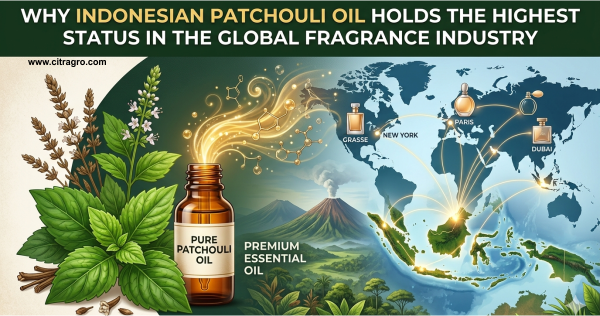
Indonesia is not merely a participant in the patchouli market; it is the undisputed king. Controlling approximately 80% to 90% of the world’s supply, the archipelago nation has transformed a simple leafy plant into a strategic commodity known in the trade as “liquid gold.”
This comprehensive guide explores the deep, multi-layered reasons behind this dominance, from the jungles of Sulawesi to the luxury boutiques of Fifth Avenue.
What is Patchouli Oil? The Foundation of Fine Fragrance
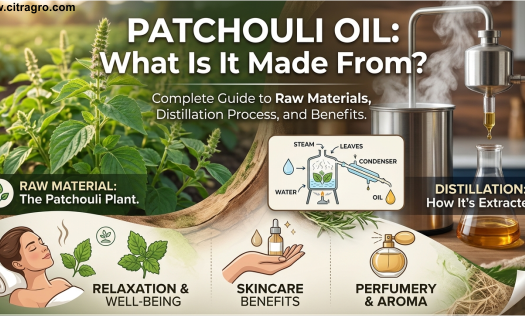
Before diving into Indonesia’s supremacy, one must understand the raw material itself. Patchouli oil is an essential oil extracted via steam distillation from the dried leaves and stems of the Pogostemon cablin plant, a member of the mint family (Lamiaceae). Unlike the cool, refreshing scent of spearmint or peppermint, patchouli offers a starkly contrasting olfactive profile: heavy, woody, earthy, slightly camphoraceous, and sweetly balsamic.
A Brief History of the “Silk Road Scent”
Patchouli’s journey to the top of the fragrance pyramid is steeped in history. In the 19th century, Indian and Chinese merchants packing silk fabrics for the long voyage to Europe discovered a practical secret. They layered dried patchouli leaves between the silk bolts to repel insects and moths.
When the cargo arrived in London and Paris, the fabric was infused with a distinct, intoxicating, exotic aroma. Rather than washing it out, European high society embraced it. The scent of patchouli became synonymous with luxury, authenticity, and the Orient. This historical accident laid the groundwork for patchouli’s permanent place in Western perfumery.
The Critical Role of Patchouli in Perfumery
To understand why the world demands Indonesian oil specifically, we must first look at what patchouli does inside a perfume bottle.
1. The Ultimate Fixative
In the architecture of a fragrance—the top notes (citrus, light fruits), heart notes (florals, spices), and base notes (woods, resins)—patchouli sits firmly in the base. Its specific chemical structure slows the evaporation rate of the more volatile, lighter molecules. This property is known as fixation.
Without a powerful natural fixative like patchouli, a $300 bottle of perfume would dissipate from the skin within 30 minutes. Patchouli provides the longevity, the sillage (the scent trail), and the lasting memory that defines fine fragrances.
2. Adding Depth and Contrast
Patchouli is a master blender. It pairs magically with rose (creating a modern, jammy feel), jasmine, sandalwood, bergamot, and even gourmand notes like vanilla and chocolate. It grounds the sweetness, preventing a perfume from smelling cloying or cheap. It adds a “dark side” to bright florals, giving the final liquid its sensuality and opulence.
Core Reasons: Why Indonesian Patchouli Oil Holds the Highest Status
While patchouli grows in other tropical regions (China, India, Brazil, and parts of Africa), none command the premium price or respect of the Indonesian product. Here is the science and tradition behind that hierarchy.
A. The Terroir: Volcanic Ash and Tropical Perfection
In the world of essential oils, terroir is everything. Just as a Pinot Noir grape tastes different in Burgundy than in California, Pogostemon cablin absorbs the unique minerals of its soil.
Indonesia sits on the Pacific “Ring of Fire,” blessed with centuries of volcanic ash deposits that have created incredibly fertile, mineral-rich soil. Specifically, in the highlands of Sulawesi, Aceh, and North Sumatra, the earth is loaded with magnesium, iron, and calcium.
When combined with consistent tropical humidity, 2,000-3,000 mm of annual rainfall, and relentless sunshine, the Indonesian patchouli plant synthesizes a much denser concentration of secondary metabolites. The result is an oil that is heavier, more complex, and significantly richer in the desired aromatic compounds compared to patchouli grown in sandy or depleted soils elsewhere.
B. Superior Chemistry: The Patchoulol Factor
If you ask a chemist why Indonesian oil is superior, they will point to one number: Patchouli Alcohol (Patchoulol) content.
Patchoulol is the sesquiterpene alcohol responsible for the characteristic woody, camphoraceous scent and the oil’s incredible fixative power. Through Gas Chromatography (GC) testing, crude Indonesian patchouli oil consistently registers Patchoulol levels between 29% and 35% . In contrast, oils from other regions often struggle to reach 25%.
Premium or Molecularly Distilled (MD) grades of Indonesian oil push this even higher. Furthermore, the supporting cast of molecules—alpha-bulnesene and alpha-guaiene—appears in a perfect ratio in Indonesian oil, creating a rounded, “full” aroma free from the harsh, metallic, or rancid undertones seen in lower-quality oils.
C. Indigenous Post-Harvest Wisdom
You cannot simply steam fresh leaves and get premium oil. The secret lies in the drying yard.
Indonesian smallholders have perfected a generations-old “curing” process:
- Harvest Timing: Stems are cut just a few centimeters above the soil exactly when the plant is at peak maturity (typically just before flowering), ensuring the glandular trichomes on the leaves are bursting with oil.
- The Withering Process (Curing): Fresh leaves contain too much water, which leads to a muddy, grassy oil if distilled immediately. Indonesian farmers meticulously shade-dry or sun-dry the leaves for several days. This triggers a mild, natural fermentation that breaks down chlorophyll and cell walls. This step allows the deep, earthy, balsamic notes to release cleanly during distillation, rather than extracting “green” or “boiled vegetable” notes.
Geographic Nuances: The Map of Indonesian Quality
Indonesia does not produce a single, homogenous oil. Global fragrance houses select specific regional profiles like a sommelier selects wine.
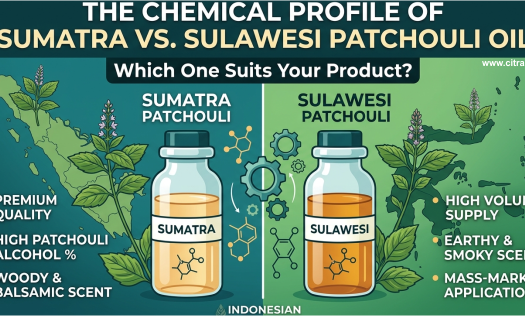
Sulawesi (South & Southeast)
- Profile: Deep yellow to rich amber (Dark Grade).
- Scent: Intense, heavy, deeply earthy, with an exotic, smoky, and slightly chocolatey nuance.
- Use: The backbone of global mass supply. Ideal for commercial fragrances, luxury soaps, laundry detergents, and industrial cosmetics.
Sumatra / Aceh
- Profile: Lighter, clearer golden hue.
- Scent: Smoother, cleaner, with fresh-green top notes and minimal smoke. Often described as “velvety.”
- Use: The crown jewel for Fine Fragrance. Highly sought after by niche perfume houses in France for haute-couture perfumes where a “dirty” or smoky patchouli would ruin the delicate balance of a floral composition.
Industrial Grades of Indonesian Patchouli Oil
To meet the stringent International Fragrance Association (IFRA) standards, Indonesian oil is processed into several tiers:
- Dark Patchouli Oil (Crude/Raw): The direct output from village stills. Dark amber, raw, earthy, and potent. Used in heavy industrial goods or shipped for refinement.
- Light Patchouli Oil: Stripped of heavy metals and dark pigments via stainless steel redistillation. Clear to pale yellow. Does not stain white clothing or skin. This is the standard for modern cosmetics.
- Molecular Distilled (MD) Patchouli Oil: The absolute crown jewel. Using low-pressure fractional distillation, harsh top notes and burnt nuances are removed. The result is virtually colorless with an incredibly elegant, clean, velvety smoothness. This is what you smell in a $500 bottle of niche perfume.
- Aged Patchouli Oil: Like vintage wine, pure Indonesian patchouli improves with age. Stored in cool, dark, airtight conditions for 1-2 years, the harsh edges mellow into a remarkably sweet, smooth, rich aroma with unparalleled tenacity.
The Supply Chain: From Smallholder to Global Luxury
Indonesia’s dominance drives a massive economic ecosystem. Over 90% of production is managed by smallholder farmers, not large corporations.
- The Human Scale: More than 500,000 farmers across Aceh, Sulawesi, and Java rely on patchouli as their primary livelihood.
- Trade Data: Indonesia’s essential oil exports contribute hundreds of millions of USD annually. Top destinations include the United States (cosmetics), France (fine fragrance), India (re-distribution and fractionation), and China (pharmaceutical blending).
If you are a buyer looking to enter this market, authenticity is key. You need a partner who bridges the gap between these remote villages and the global stage. This is why connecting with an Indonesia’s Premium Patchouli Oil Supplier for Export is the first critical step for any serious fragrance house.
Sustainability: The New Frontier for Indonesian Patchouli
Today, the question of “Why Indonesian Patchouli Oil Holds the Highest Status” is no longer just about scent—it is about ethics. Luxury consumers demand traceability.
Global giants like Givaudan, Firmenich, and Symrise are now investing heavily in Indonesian supply chains to ensure:
- Eco-Friendly Farming: Training farmers to use organic compost and intercropping (planting patchouli with corn or cacao) to protect biodiversity.
- Energy-Efficient Distillation: Moving away from firewood to “eco-stills” powered by biomass waste (the dried, spent leaves themselves), drastically slashing the carbon footprint.
- Digital Traceability: Using blockchain technology to trace a drum of oil back to the specific GPS coordinates of the farm where it was grown (COSMOS and Ecocert certifications are now standard).
Why Synthetic Substitutes Fail
With modern chemistry, scientists have synthesized single molecules like Patchoulol in a lab. Why do they fail to replace the natural Indonesian product?
Complexity. Natural Indonesian patchouli oil contains over 140 different chemical constituents interacting in “chaotic harmony.” A synthetic replica offers a flat, linear, “cardboard” version of the scent. It lacks the living, breathing soul of the natural oil. To a trained “nose” (perfumer), a fragrance made without natural Indonesian patchouli feels dead, thin, and lacks the luxury finish required for high-end branding.
How to Identify Premium Indonesian Patchouli Oil
For formulators and buyers, here is how to verify quality:
- Read the CoA (Certificate of Analysis): Look for a GC-MS report. Ensure Patchouli Alcohol is above 29% . Below that indicates poor quality.
- Check Physical Constants: Pure oil has a specific gravity of 0.952 to 0.975 at 20°C. Wide deviation suggests adulteration.
- The Blotter Test: Place a drop on a scent strip. Poor oil will smell harsh or alcoholic. Premium Indonesian oil will unfold slowly over hours, radiating a rich, wet-earth, velvety scent that lasts for days.
Conclusion: An Irreplaceable Natural Legacy
The answer to Why Indonesian Patchouli Oil Holds the Highest Status in the Global Fragrance Industry is not found in marketing hype, but in the convergence of volcanic geology, tropical meteorology, sophisticated chemistry, and generational wisdom.
No other nation can replicate the specific mineral content of the Ring of Fire. No synthetic factory can copy the chaotic molecular perfection of a sun-dried Sulawesi leaf. Indonesia is not just a supplier of a commodity; it is the spiritual and physical home of the base note that anchors the world’s most beloved perfumes.
From the dusty fields of Aceh to the glossy shelves of Sephora, Indonesian patchouli remains the undisputed benchmark. For buyers seeking to capture that magic, working with a verified, ethical supplier is paramount. Explore your sourcing options with a trusted partner like Indonesia’s Premium Patchouli Oil Supplier for Export to ensure your fragrance line carries the true soul of the archipelago.
Frequently Asked Questions (FAQ)
Q: Can I apply pure Indonesian patchouli oil directly to my skin as a perfume?
A: No. Undiluted essential oil is highly concentrated and can cause skin sensitization. Always dilute it with a carrier oil (like jojoba or fractionated coconut oil) or use it within an approved cosmetic formulation.
Q: Why does patchouli oil price fluctuate so much?
A: Because Indonesia controls ~90% of the supply, weather is the main factor. El Niño cycles (droughts) or La Niña (excess rain/flooding) in Sulawesi or Sumatra drastically affect harvest volumes, causing global price volatility.
Q: Is Indonesian patchouli oil sustainable?
A: Increasingly, yes. While there are historic concerns about deforestation for distillation fuel, major multinational partnerships are converting farms to biomass recycling and reforestation programs. Look for suppliers offering Ecocert or COSMOS certification.
Q: Does patchouli oil get better with age?
A: Absolutely. Freshly distilled Indonesian patchouli can smell a bit “sharp” or “raw.” Properly aged for 12-24 months, it becomes smoother, sweeter, and significantly more complex—much like a fine whiskey.
Ready to Source Premium Indonesian Patchouli Oil? Consult Your Needs Now!
Contact our expert team for the highest-grade Indonesian patchouli oil—whether for export, luxury perfume compounding, or large-scale cosmetic manufacturing.
📱 WhatsApp: +6285253037202
🌿 Patchouli Oil Consultation – Citragro Indonesia
- Website: www.citragro.com
- Email: citragro@gmail.com
🏢 Business & Property Consultation – Yonathan Chen
- Website: www.yonathanchen.com
- Email: yonathanchen27@gmail.com
Get export-quality Indonesian patchouli oil directly from trusted local sources. Our team is ready to assist you with technical specifications (Patchoulol alcohol, GC-MS), oil grades (Dark/Light/MD), and worldwide shipping.