
What Is Patchouli Oil Made Of? The Complete Guide to Ingredients, Production, and Business Potential
Have you ever worn a perfume that lasts all day? Or used a natural mosquito repellent lotion with that distinct, earthy, and long-lasting scent? Behind many of these products lies a secret ingredient: patchouli oil. But the fundamental question that often arises is: What is patchouli oil made of?
Whether you are a fragrance industry professional, an essential oil business owner, or simply a natural wellness enthusiast, understanding the origin and production process of patchouli oil is the first step to appreciating its high value. This pillar article will explore everything about patchouli oil—from the plant species and the specific parts used to the distillation process and international quality standards.
As a key fact: Indonesia is the world’s largest producer of patchouli oil, supplying 80–90% of the global market. Let’s uncover the secrets behind this “liquid gold” from the tropics.
What Is Patchouli Oil? Meet the Powerful Fixative
Before answering what is patchouli oil made of, let’s define it. Patchouli oil (also known as nilam oil) is an essential oil extracted from the leaves of the patchouli plant (Pogostemon cablin Benth). Its aroma is unmistakable: earthy, woody, slightly sweet, and heavy. This unique scent profile makes it highly valuable in the perfume industry.
Its main superpower is being a fixative—a substance that binds and stabilizes volatile fragrance molecules. In perfumery, many floral or fruity scents evaporate quickly. Patchouli oil locks those molecules in, making the fragrance last 8–12 hours or more on skin.
Beyond perfumery, patchouli oil is known for:
- Natural antiseptic for minor wounds and acne
- Anti-inflammatory effects for skin conditions like eczema
- Natural insect repellent (especially effective against mosquitoes)
- Stress relief in aromatherapy (reduces cortisol levels)
However, all these benefits depend on one crucial factor: the purity and quality of the raw material. So let’s answer the core question directly.
What Is Patchouli Oil Made Of? The Scientific and Practical Answer
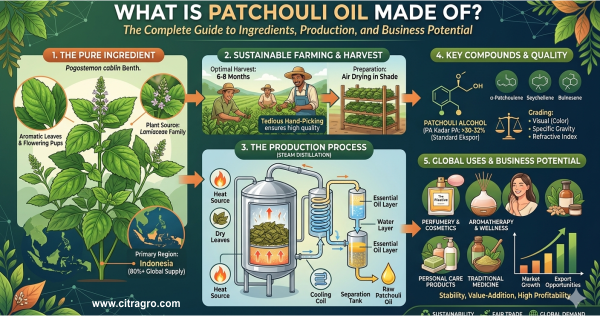
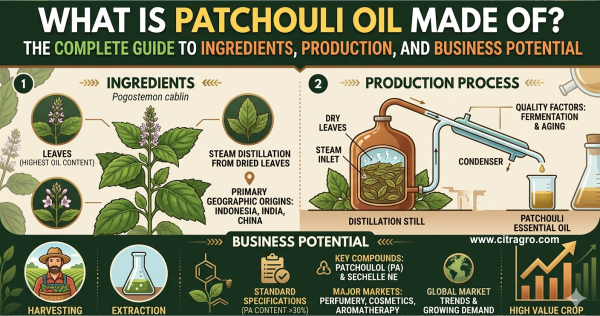
Patchouli oil is made from the dried leaves and tender shoots of the patchouli plant (Pogostemon cablin), which have been wilted and then steam-distilled.
Yes, although the entire plant contains some aromatic compounds, the leaves and shoots have the highest concentration of essential oil. Stems and roots contain very little oil and are generally not used in commercial production.
Botanical Details of the Patchouli Plant
Patchouli belongs to the Lamiaceae family (mint family). Key characteristics:
- Leaves are egg-shaped with serrated edges
- Leaf surface is slightly hairy (trichomes) where oil glands are stored
- Plant grows up to 1 meter tall
- Thrives in humid tropical regions with annual rainfall of 2500–3000 mm
There are three main botanical types of patchouli:
| Patchouli Type | Scientific Name | Oil Content | Primary Use |
|---|---|---|---|
| Aceh/Sulawesi Patchouli | Pogostemon cablin | Highest (2.5–4%) | Export, luxury perfumes |
| Java Patchouli | Pogostemon heyneanus | Medium (1.5–2.5%) | Mid-range fragrances |
| Forest Patchouli | Pogostemon hortensis | Low (<1%) | Rarely used commercially |
So, when you ask what is patchouli oil made of in an industrial context, the answer is: the leaves of Pogostemon cablin grown intensively.
Production Process: From Farm to Bottle
Knowing the raw material is only half the story. The next question: how do patchouli leaves turn into precious drops of oil? This process requires expertise and attention to detail, as a single mistake can drastically reduce quality.
Step 1: Planting and Cultivation
Patchouli is not grown from seeds but from stem cuttings (10–15 cm long). Farmers plant them in partially shaded fields. The plant is ready for harvest at 6–8 months of age.
Step 2: Timely Harvesting
Harvest timing is critical. Leaves contain the highest oil concentration when:
- The plant is 6–7 months old
- The weather has been sunny (no rain) for 2–3 days prior
- Harvesting is done in the morning after dew has dried
Farmers cut the leaves and shoots using sickles or by hand. One hectare of land can yield 10–15 tons of fresh leaves per year.
Step 3: Wilting – The Key to Unlocking Oil Glands
This step separates high-quality patchouli oil from average ones. Freshly picked leaves are not distilled immediately. Why? Because the oil glands are still intact and closed.
Wilting is done by spreading the leaves on bamboo mats or tarpaulins for 1–3 days in a shaded area (not direct sunlight). During wilting:
- Leaf moisture content drops from 80% to approximately 60%
- Oil gland cell walls break down enzymatically
- Precursor compounds transform into patchouli alcohol (PA)
The result? Oil yield increases by up to 30% compared to distilling fresh leaves.
Step 4: Distillation – Steam and Water Method
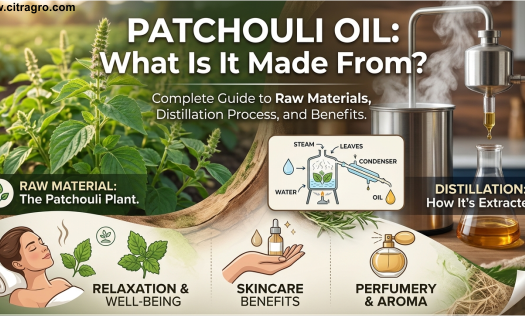
Technically speaking, what is patchouli oil made of in a chemical engineering sense? It is the condensate from steam distillation. The most common method in Indonesia is direct steam distillation. Here are the steps:
- Loading the material: Wilted patchouli leaves are packed into a distillation boiler (made of stainless steel or copper).
- Steam injection: Hot steam at 100–120°C is introduced from the bottom, passing upward through the leaf pile.
- Oil extraction: Steam breaks the oil glands and carries volatile molecules (mainly patchouli alcohol) to the vapor pipe.
- Condensation: The steam, now saturated with oil, passes through a water-cooled condenser and turns back into liquid.
- Separation: The liquid exiting is a mixture of water (hydrosol) and patchouli oil. Because patchouli oil has a lower density (0.95–0.97) than water, it floats on top and is separated.
- Drying: The oil is dried using anhydrous salt or centrifugation to remove residual water.
This process takes 4–8 hours depending on boiler capacity. Average yield: 2–3% (meaning 100 kg of dried leaves produce 2–3 liters of patchouli oil).
Step 5: Purification and Aging
Crude patchouli oil still contains fine waxes and impurities. Filtration using filter paper or a filter press is necessary. After that, the oil is stored in stainless steel drums or dark glass bottles in a cool room (20–25°C).
Interestingly, unlike most essential oils that degrade over time, patchouli oil improves with age. An aging process (6–12 months of storage) results in:
- A softer, more “mature” aroma
- A natural increase in patchouli alcohol content
- Loss of raw, harsh, green notes
This is why high-end perfumes use patchouli that has been aged for at least one year.
Chemical Composition: Patchouli Alcohol – The Star Molecule
To answer what is patchouli oil made of at a molecular level, we must talk about patchouli alcohol (PA). This sesquiterpene alcohol is the primary marker of quality.
Gas chromatography (GC) analysis reveals the main components:
| Compound | Percentage | Role |
|---|---|---|
| Patchouli Alcohol (PA) | 30–45% | Primary fixative, earthy aroma |
| Alpha-Bulnesene | 10–15% | Woody scent contribution |
| Alpha-Guaiene | 8–12% | Oxidative stability |
| Seychellene | 5–10% | Synergistic effect with PA |
| Pogostol | 3–7% | Antimicrobial activity |
Minimum export standard requires PA content ≥30%. Super-premium patchouli oil can reach 40–45% PA. Avoid oils with PA below 25%, as this indicates adulteration or poor raw material.
Benefits and Applications Across Industries
After understanding what is patchouli oil made of, let’s see why this ingredient is so sought after.
1. Perfume & Cosmetics Industry (70% of global consumption)
- Fixative in mid-range to luxury perfumes
- Scent for soaps, detergents, and room fresheners
- Base note for masculine fragrances due to its earthy, woody character
2. Aromatherapy & Wellness
- Anxiety relief: Studies show inhaling patchouli reduces cortisol levels by 20%
- Antifungal: Effective against Candida albicans
- Wound healing: Accelerates skin cell regeneration
3. Skincare Products
- Anti-acne creams (antibacterial effect)
- Lotions for dry, cracked skin
- Anti-dandruff shampoos
4. Natural Insect Repellent
- Mosquito repellent lotions (comparable to DEET 30% but safer)
- Protects wool clothing from moths
International Quality Standards: Making Patchouli Oil Export-Ready
For business owners, knowing what is patchouli oil made of is not enough. You must also understand the quality parameters that global buyers look for. The main references are SNI 06-2385-2006 (Indonesia) and ISO 3757:2002 (International).
| Parameter | SNI Standard | Premium Oil |
|---|---|---|
| Color | Light yellow to reddish brown | Golden yellow |
| Specific gravity (25°C) | 0.950 – 0.975 | 0.955 – 0.965 |
| Refractive index (25°C) | 1.507 – 1.515 | 1.509 – 1.512 |
| Patchouli Alcohol content | Minimum 30% | 35–45% |
| Solubility in 90% ethanol | Clear (1:10) | Perfectly clear |
| Acid value | Max 8 mg KOH/g | <5 mg KOH/g |
Heavy metal contamination (especially iron and lead) is a common issue for Indonesian exports due to the use of cast iron distillation equipment. The solution: use stainless steel 304 or 316 for all surfaces that contact the oil.
Business Opportunities and Challenges in Patchouli Oil
Indonesia is the world’s largest producer, but that doesn’t mean there are no challenges. Let’s analyze the potential.
Why Is Patchouli Oil a Promising Business?
- Stable demand: The global perfume industry grows 4–5% annually. Patchouli is always needed.
- Competitive prices: International patchouli oil prices range from 50–80/kg(standardquality)to120–150/kg (organic + high PA).
- Value-added processing: Purifying patchouli into patchouli alcohol isolate (95%+ PA) can sell for $300–500/kg.
- Geographical advantage: Patchouli from Central Sulawesi and Aceh has the aroma profile most preferred by French perfume houses.
Challenges to Overcome
- Adulteration: Mixing with mineral oil, kerosene, or synthetic patchouli damages trust.
- Price volatility: Long dry seasons can reduce yield by up to 50%.
- Outdated technology: Many smallholders still use iron boilers that contaminate the oil.
- Logistics: Production centers are in remote areas, incurring high transport costs.
Success Strategies for Businesses
- Build vertical partnerships: Work with farmers using profit-sharing and post-harvest training.
- Invest in testing equipment: At minimum, have a refractometer and pycnometer to check specific gravity.
- Organic certification: European buyers pay a 30–50% premium for USDA Organic or ECOCERT certified oil.
- Product differentiation: Sell in small bottles (5–50 ml) for the home aromatherapy market with higher margins.
Common Mistakes and Myths About Patchouli Oil
Let’s correct some misunderstandings.
Myth 1: “Patchouli oil is made from stems and roots”
Fact: Only leaves and shoots contain significant oil. Stems contain <0.5% oil and actually produce an undesirable “green” aroma.
Myth 2: “Older leaves have higher oil content”
Fact: Peak oil content is at 6–8 months. Leaves older than 12 months become tough and yield less oil.
Myth 3: “Authentic patchouli oil is always dark”
Fact: High-quality pure patchouli oil is clear yellow to golden yellow. Dark brown or black indicates oxidation or contamination.
Myth 4: “You can apply it directly to skin”
Fact: Patchouli oil is a concentrated essential oil that can cause irritation. Always dilute with a carrier oil (coconut, jojoba, almond) at 2–3 drops per 10 ml of carrier.
How to Tell Real Patchouli Oil from Fake
As a consumer or business owner, you need to detect adulteration. Here are simple tests:
| Parameter | Genuine Oil | Fake/Adulterated Oil |
|---|---|---|
| Aroma | Earthy, woody, long-lasting | Sweet/chemical smell, fades quickly |
| Solubility in 90% alcohol | Completely clear | Cloudy or leaves residue |
| Paper test | Evaporates without greasy stain | Leaves a permanent oily ring |
| Viscosity | Slightly thick | Too thin or too thick |
| Price | Cannot be below $40/kg | Suspiciously cheap (<$30/kg) |
Most reliable test: Send a sample to a lab for GC-MS analysis. Although it costs $50–100 per sample, it is the only way to be certain for patchouli oil exports.
Conclusion: Why Understanding “What Is Patchouli Oil Made Of” Matters
Answering what is patchouli oil made of is not just botanical trivia. It is the foundation for understanding the value chain of one of Indonesia’s leading export commodities.
Patchouli oil is made from the wilted leaves and shoots of Pogostemon cablin, which are then steam-distilled to produce an essential oil rich in patchouli alcohol. Its quality is determined at every step: from seedling variety, harvest age, wilting technique, boiler material, to post-production storage.
For Indonesia, patchouli is more than a commodity. It is a natural heritage that, if managed with quality and integrity, can continue to lead the global fragrance market. For business owners, focusing on purity, consistency, and buyer education is the key to long-term growth.
Ready to Start a High-Quality, Export-Ready Patchouli Oil Business? Consult Us Now!
You now understand that patchouli oil is made from Pogostemon cablin leaves distilled using the right technology. But knowledge alone isn’t enough. You need expert guidance.
✅ Consultation on Natural Products & Essential Oils (Alma Indonesia via Citragro Indonesia)
Get complete information on:
- Supply of high-quality patchouli leaves
- Export-ready distillation techniques (heavy metal-free)
- Organic certification and laboratory analysis
📞 WhatsApp: +6285253020372
🌐 Website: www.citragro.com
📧 Email: citragro@gmail.com
✅ Business & Property Investment Consultation (Yonathan Chen)
Looking for patchouli farm land or strategic property? We can help you with:
- Land feasibility analysis for agribusiness
- Legal permits for essential oil businesses
- Green property investment with added value
📞 WhatsApp: +6285253020372
🌐 Website: www.yonathanchen.com
📧 Email: yonathanchen27@gmail.com
Don’t miss the golden opportunity of the patchouli oil industry, which sees stable demand year after year. Contact us now for a free initial consultation!
Frequently Asked Questions (FAQ)
1. Is patchouli oil the same as cajuput oil?
No. Cajuput oil comes from distilling Melaleuca cajuputi leaves. They are different species with different chemical compositions.
2. What is the current market price of patchouli oil per kg?
Prices fluctuate based on quality. As of 2025: standard quality (PA 30–32%) is around 50–70/kg;premiumquality(PA3590–130/kg.
3. Is patchouli oil safe during pregnancy?
Consult a doctor. Generally, topical use at very low dilution (1% in carrier oil) is considered safe during the second and third trimesters.
4. How long can patchouli oil be stored?
If stored in a dark glass bottle, tightly sealed, at room temperature, patchouli oil can last 5–10 years or more. Aging actually improves its aroma.
5. Can I make patchouli oil at home?
Technically possible with a small distillation apparatus, but yields are extremely low (you need tens of kg of leaves for a few ml) and safety risks are high. It is better to buy from a reputable producer.