
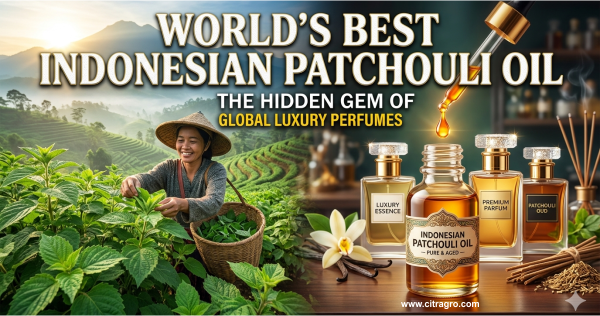
World’s Best Indonesian Patchouli Oil: The Hidden Gem of Global Luxury Perfumes
The Secret Behind World-Class Perfumes
Have you ever wondered why luxury perfumes from Chanel, Dior, or Gucci last all day on your skin? The answer lies in the World’s Best Indonesian Patchouli Oil. Behind the glamorous bottles of global fragrances is a humble tropical leaf that grows abundantly across the Indonesian archipelago.
International trade data confirms that Indonesia is the absolute ruler of this commodity, supplying 80% to 90% of the world’s patchouli oil needs. No other country—not China, not India—can match the aroma quality and chemical consistency produced by Pogostemon cablin from the Nusantara region.
This pillar article will reveal: why Indonesian patchouli oil is so dominant, the chemical secrets behind its quality, the production centers, export-grade distillation techniques, and the future of downstream investment opportunities.
1. The Patchouli Plant – Green Gold in Disguise
1.1 Taxonomy and Morphology
Patchouli (Pogostemon cablin Benth) is a tropical shrub belonging to the Lamiaceae family (mint family). It grows upright to 1–1.5 meters with hairy leaves and serrated edges. Unlike other essential oils extracted from flowers or seeds, patchouli oil comes from leaves and twigs through steam distillation.
1.2 Three Main Varieties Worldwide
Not all patchouli is created equal. Botanists recognize three varieties:
- Pogostemon cablin Benth: The Aceh/Java superior variety. Highest oil yield, most complex aroma.
- Pogostemon heyneanus: Forest patchouli from Java. Inferior aroma, mostly for traditional use.
- Pogostemon hortensis: Soap patchouli. Low oil content, rarely distilled.
Indonesia dominates the first variety—the very reason for the World’s Best Indonesian Patchouli Oil claim.
1.3 Unique Trait: The Older, The Better
Patchouli oil has a unique property: it ages like fine wine. When stored in cool, dark conditions, its color changes from pale yellow to golden brown, and its aroma becomes smoother, sweeter, and more valuable over time.
2. Why Indonesian Patchouli Oil is the World’s Best – 4 Absolute Advantages
There is no empty claim in this industry. Perfumers in Grasse, France, and aroma labs in New York all agree: the World’s Best Indonesian Patchouli Oil stands alone. Here is the scientific and industrial proof.
2.1 Exceptionally High Patchouli Alcohol (PA) Content
The primary quality parameter is Patchouli Alcohol (PA) , a sesquiterpene compound that gives the characteristic woody-earthy scent.
- ISO 3757 & SNI 06-2385-2006 standards: Minimum 30% PA.
- Indonesian patchouli oil: Consistently 32% – 38% PA.
- Chinese/Indian patchouli oil: Average only 25% – 28% PA.
With high PA, just a few drops of Indonesian nilam can provide a powerful fixative effect in luxury perfumes.
2.2 Complex and Balanced Aroma Profile
Patchouli oil from other countries often has a sharp, smoky, or raw herbal note. In contrast, the World’s Best Indonesian Patchouli Oil offers a perfect harmony of:
- Woody (like sandalwood)
- Earthy (wet soil after rain)
- Sweet-balsamic (honey-like natural sweetness)
- Light camphoraceous (slight coolness in the nose)
This balance cannot be artificially recreated in a laboratory.
2.3 The World’s Best Natural Fixative
In perfumery, a fixative binds light aroma molecules (like citrus or florals) so they don’t evaporate quickly. Patchouli oil has large, complex sesquiterpene molecules that can extend a perfume’s longevity to 8–12 hours on human skin. No synthetic material perfectly mimics this function.
2.4 The Nusantara Terroir Effect
Experts call terroir (soil, climate, altitude) the main reason for Indonesia’s patchouli superiority.
- Volcanic soil: Rich in organic nitrogen and potassium.
- Rainfall 2000–3000 mm/year: Maintains ideal humidity.
- Altitude 100–600 masl: Temperature 25–28°C stimulates dense glandular trichomes (oil glands) on leaves.
The result? World’s Best Indonesian Patchouli Oil has up to 30% denser oil glands than varieties from other countries.
3. Indonesian Patchouli Production Centers (2026 Update)
Growing regions continue to expand as global demand rises. Here are the main centers that keep the World’s Best Indonesian Patchouli Oil sovereign.
| Region | Variety | Specific Advantage |
|---|---|---|
| Aceh (Aceh Jaya, South, West) | Pogostemon cablin (original) | Highest PA (34-38%), smoothest aroma. Known as the “Cognac of Patchouli”. |
| West & North Sumatra | Pogostemon cablin | Stable production, low moisture content, long shelf life. |
| Central & East Java | Pogostemon cablin & hybrids | Modern distillation (stainless steel), export traceability. |
| Sulawesi (South, Southeast, Central) | Pogostemon cablin expansion | New fertile lands, massive volume, long-term export potential. |
2026 Note: Sulawesi has become a new power supplying volume, while Aceh maintains its status as the world’s number one premium producer.
4. Export Market Data & Economic Value
4.1 Uncontested Figures
Based on Ministry of Trade and Ministry of Industry data (2023–2025):
- Total Indonesian essential oil exports: USD 250–300 million per year.
- Patchouli oil contribution: 54% of total national essential oil exports.
- Patchouli oil export value alone: USD 141.32 million (over IDR 2.3 trillion).
- Annual export volume: 3,500 – 4,500 metric tons.
4.2 Top Destination Countries
- United States (30%): Luxury perfumes, cosmetics, aromatherapy.
- France (25%): Global perfume hub in Grasse.
- Singapore (15%): Trading hub and re-refining.
- India (12%): Agarbatti (incense) and soap industry.
- Switzerland & Germany (10%): Pharmaceuticals and aroma research.
4.3 Employment Absorption
The patchouli industry supports more than 200,000 workers in Indonesia, including:
- Smallholder farmers (0.25–1 hectare plots)
- Small-scale distillers
- Collecting traders
- Registered exporters
No wonder the World’s Best Indonesian Patchouli Oil is also a pillar of the people’s economy.
5. Production Process – From Garden to Export Drum
To maintain the status of World’s Best Indonesian Patchouli Oil, every step must be precise. A single mistake in drying can cut the price by half.
5.1 Seed Selection & Planting
- Disease-free superior seedlings (free from Ralstonia solanacearum bacterial wilt).
- Stem cuttings from productive mother plants (6–12 months old).
- Planting distance 80×80 cm or 100×100 cm.
- Natural shade (coconut or sengon trees) for the first 2 months.
5.2 Timely Harvest
- Harvest age: 6–8 months after planting.
- Signs of readiness: Lower leaves turn yellow, branches become dense.
- Best harvest time: Morning (6:00–9:00 AM) or late afternoon (3:00–6:00 PM) to avoid essential oil evaporation.
5.3 The Secret Curing Process
Leaves must not be distilled immediately. Wilt for 3–5 days on bamboo racks in the shade (no direct sunlight) until moisture content drops from 70% to 15-18%. During this curing, enzymatic hydrolysis breaks down cell walls, releasing more essential oil.
5.4 Export-Grade Steam Distillation
Modern industry uses steam distillation with stainless steel SS 304/316 boilers.
- Steam pressure: 1–2 bar.
- Temperature: 100–120°C.
- Distillation time: 4–6 hours per cycle.
- STRONG PROHIBITION: Using old iron drums causes chelation, turning the oil black and failing heavy metal tests at international labs.
5.5 Final Product
After condensation and oil-water separation, crude patchouli oil is obtained with a yield of 2–3% of dry leaf weight. Color: clear yellow to reddish brown. Aroma: characteristic woody-earthy with a sweet note.
6. Chemical Properties & International Quality Standards
For exporters, understanding laboratory parameters is non-negotiable. Below is the SNI 06-2385-2006 standard, globally recognized:
| Parameter | Standard Value |
|---|---|
| Appearance | Yellow – reddish brown, clear |
| Specific gravity (20°C) | 0.950 – 0.975 |
| Refractive index (20°C) | 1.507 – 1.515 |
| Patchouli Alcohol (PA) | Minimum 30% |
| Water content | Negative |
| Solubility in 90% ethanol | 1:1 to 1:10 (clear) |
| Acid value | Max 8.0 mg KOH/g |
Besides PA, minor compounds like alpha-patchoulene, beta-patchoulene, seychellene, and alpha-bulnesene also contribute to the unique aroma profile of the World’s Best Indonesian Patchouli Oil.
7. Multi-Sector Benefits of Patchouli Oil
Why does global demand never fade? Because patchouli oil has one of the widest benefit spectrums among all essential oils.
7.1 Luxury Perfume Industry (50% of global consumption)
- As base notes that are masculine, oriental, and exotic.
- As a natural fixative that extends perfume longevity.
- Used by Chanel, Dior, Gucci, Tom Ford, Jo Malone.
7.2 Cosmetics & Skincare (25%)
- Anti-inflammatory: Alpha-bulnesene reduces redness and irritation.
- Antiseptic & antifungal: Fights acne and dandruff.
- Anti-aging: Stimulates skin cell regeneration.
- Products containing patchouli: Premium soaps, eczema lotions, anti-dandruff shampoos, anti-aging creams.
7.3 Aromatherapy & Medical (15%)
- Reduces anxiety: Clinical studies show patchouli inhalation lowers cortisol levels by up to 24%.
- Treats insomnia: Mild sedative effect without addiction.
- Wound healing: Accelerates tissue regeneration in first and second-degree burns.
7.4 Natural Insect Repellent (10%)
- Dried patchouli leaves are traditionally placed in wardrobes to protect wool fabrics from moths.
- Pure patchouli oil is toxic to Aedes aegypti mosquitoes (dengue vector), making it an active ingredient in organic anti-mosquito lotions.
8. Challenges Facing the Indonesian Patchouli Industry
Despite holding the title of World’s Best Indonesian Patchouli Oil, the sector faces at least 4 major challenges.
8.1 Extreme Price Volatility
Farm-gate prices can swing dramatically:
- Boom cycle: IDR 800,000 – 1,200,000/kg (during scarcity).
- Bust cycle: IDR 200,000 – 400,000/kg (during oversupply).
As a result, farmers often switch to other commodities (corn, chili) when prices drop, causing supply shortages and another price spike. Indonesia remains a price taker, not a price maker.
8.2 Adulteration Practices
Unscrupulous collectors mix pure patchouli oil with:
- Keruing or gurjun oil (cheaper)
- Synthetic fractions
- Crude palm oil
This damages export reputation and leads to rejections at destination ports. GC-MS (Gas Chromatography-Mass Spectrometry) testing is now mandatory for serious exporters.
8.3 Minimal Downstream Processing
90% of Indonesian exports remain crude patchouli oil. The highest value addition is captured by France and Switzerland, who have fractionation technology to isolate pure Patchouli Alcohol crystals worth 5–10 times the price of crude oil.
8.4 Disease Threats & Climate Change
- Bacterial wilt (Ralstonia solanacearum): Can wipe out a plantation in 2 weeks.
- Root-knot nematodes: Inhibit nutrient absorption.
- Climate change: Prolonged dry seasons reduce oil yield by up to 40%.
9. Downstream Strategy & Investment Opportunities
The government and research institutions (BRIN, Atsiri Research Center – USK Aceh) have launched aggressive downstream programs to strengthen the position of World’s Best Indonesian Patchouli Oil.
9.1 Local Fractionation Facilities
Target 2025–2030: Build 3–5 fractionation plants in Aceh, East Java, and South Sulawesi. These will process crude oil into:
- Patchouli alcohol crystals (99% purity)
- Rectified patchouli oil (colorless, free of heavy compounds)
- Fractionated patchouli oil (for high-end perfumes)
9.2 Sustainability & Fair Trade Certification
European and US buyers now require:
- ISO 3757 (chemical quality)
- Fair for Life (social)
- COSMOS (organic cosmetics)
Certified farmers and distillers can earn a 20-30% premium above market price.
9.3 Supply Chain Digitalization
A blockchain platform is being tested to track patchouli oil from farm to port. This ensures traceability and anti-counterfeiting, boosting global buyer confidence.
9.4 Investment Opportunities
For local and foreign investors, patchouli downstream offers:
- Internal rate of return (IRR) 25–35% per year.
- Payback period 3–5 years.
- Tax incentives from the government (tax holidays, super deduction tax).
10. The Future of Indonesian Patchouli Oil (2026–2030)
With policy and technology support, the World’s Best Indonesian Patchouli Oil is projected to:
- Capture 95% of the global premium market by 2030.
- Export value reach USD 300 million per year.
- Absorb 300,000 new workers.
- Become a strategic commodity alongside palm oil and rubber.
Three innovations will drive the leap:
- Disease-resistant transgenic patchouli (BRIN field trials ongoing).
- Solar-powered distillation to lower production costs.
- Integrated bio-refinery producing patchouli oil, organic fertilizer, and bioenergy from leaf waste.
Conclusion: Preserving the Fragrant Glory of the Archipelago
The title of World’s Best Indonesian Patchouli Oil is not just a marketing claim; it is a scientific and economic fact acknowledged by the global perfume industry. The unique combination of the highest Patchouli Alcohol content, the most balanced woody-earthy aroma, and the perfect natural fixative function makes Indonesian patchouli an irreplaceable foundation for the world’s most expensive perfumes.
However, this glory must be carefully maintained. Farmers need to adopt superior seeds and modern distillation. Associations and the government must eradicate adulteration. And investors must see downstream processing as a long-term opportunity, not just raw export.
With strong synergy, the World’s Best Indonesian Patchouli Oil will not only bring international prestige but also prosperity to hundreds of thousands of families in remote Aceh and the slopes of Sulawesi. It is time for Indonesia to move from being a mere raw material supplier to becoming a global value chain leader in this extraordinary commodity.
Ready to Seize the Patchouli Oil Business Opportunity? Contact Us Now!
Get expert consultation and supply of the World’s Best Indonesian Patchouli Oil from trusted sources.
- Natural Products – Citragro Indonesia
🌐 www.citragro.com
📧 citragro@gmail.com
📞 WhatsApp: +6285253020372 - Business & Property Consulting – Yonathan Chen
🌐 www.yonathanchen.com
📧 yonathanchen27@gmail.com
Become part of the global value chain of premium patchouli oil. We are ready to assist you from upstream to downstream.
👉 Partner with Indonesia’s Premium Patchouli Oil Supplier for Export – We provide certified, traceable, and sustainably distilled patchouli oil with PA content guaranteed above 34%. Contact our export team for bulk orders and long-term supply agreements.
FAQ (Frequently Asked Questions) – SEO Pillar
1. What makes Indonesian patchouli oil the world’s best?
It has the highest Patchouli Alcohol (PA) content (34-38%, above ISO 30%), a balanced woody-earthy aroma, and the best natural fixative properties for luxury perfumes.
2. What is the current price of patchouli oil per kg (2026)?
Prices fluctuate between USD 25 – 60/kg depending on quality, PA content, and global supply. Premium export-grade can reach USD 70-80/kg.
3. How can I tell real patchouli oil from fake?
Simple test: drop on paper. Real oil leaves a slowly drying spot with a sweet earthy smell. Fake oil dries quickly or smells sharp/solvent-like. GC-MS lab testing is the gold standard.
4. Is patchouli oil safe for skin?
Yes, when diluted (0.5-2% in a carrier oil). Do not apply undiluted as it may cause irritation. Consult an aromatherapist for medical use.
5. Where can I buy authentic Indonesian patchouli oil for business?
Contact registered exporters at the Ministry of Trade, the Indonesian Essential Oil Association (Atsiri Indonesia Association), or farmer cooperatives in Aceh, East Java, and South Sulawesi. You may also reach out to Indonesia’s Premium Patchouli Oil Supplier for Export directly.